A useful research paper summary is not a shorter version of every section. It is a structured record of what the paper asked, how the authors investigated it, what they found, and where the evidence stops. The goal is to make your later work easier without flattening uncertainty or replacing the original paper.
The template below is designed for students, researchers, and evidence-focused readers. You can use it for one article, adapt it to a literature review, or keep it as a standard source note in your research library. Complete it in your own words, attach precise page or figure locators, and return to the paper whenever a claim matters.
1. Start with the decision your summary must support
Before copying the citation or reading the abstract again, write one sentence explaining why you opened the paper. Your purpose controls the depth of the note.
You might be deciding whether the paper belongs in a literature review, whether its method can inform your project, whether its findings challenge another source, or whether it provides background for a concept. A summary for quick triage can be compact. A summary that will support an argument, protocol, or research decision needs more methodological detail.
Use this opening prompt:
My purpose: I am reading this paper to understand, compare, verify, or use ______.
Then add a stopping rule. For example: “If the population and outcome do not match my question, I will record the mismatch and stop after the relevance scan.” This keeps the summary tied to a real task rather than rewarding length for its own sake.
If you want contextual help while working through difficult passages, the AI reading assistant can support navigation and questions. Treat any generated explanation as provisional, and verify retained details against the paper.
2. Copy this research paper summary template
Create one note per paper and fill the fields that matter for your purpose. “Not reported,” “unclear,” and “not evaluated” are valid entries; they are better than guesses.
Identity and purpose
- Full citation:
- Stable identifier or URL:
- Date accessed:
- My purpose for reading:
- One-sentence relevance decision:
Research question and context
- Problem or gap addressed:
- Stated research question or objective:
- Authors’ proposed contribution:
- Key terms or concepts as defined in the paper:
Methods
- Study or paper type:
- Setting, population, corpus, or data source:
- Sample size and selection process:
- Comparison, control, or counterfactual:
- Measures, materials, and procedures:
- Analysis approach:
- Registration, protocol, data, code, or supplements:
Findings and evidence
- Primary reported finding:
- Magnitude, direction, and uncertainty:
- Figure, table, or passage that supports it:
- Secondary findings relevant to my question:
- Results that did not support the expectation:
Interpretation and boundaries
- Authors’ interpretation:
- My interpretation:
- Limitations reported by the authors:
- Additional limitations or unanswered questions:
- What this paper does not establish:
Use and follow-up
- How this changes or confirms my understanding:
- Connection to another source:
- Potential use in my project:
- Citation-ready paraphrase with locator:
- Exact quotation, only if needed, with locator:
- References or later papers to follow:
3. Write the one-sentence core without overstating it
After a first pass, write a single sentence in this pattern:
The authors used [design/data] to examine [question] in [population/context] and reported [main result], with [important limitation or uncertainty].
This sentence forces the claim to remain attached to the method and setting. “The intervention improved attention” may be too broad. A more accurate note identifies who received what, what comparison was used, how attention was measured, how large the observed difference was, and what uncertainty remains.
Match your verbs to the design. An observed association is not automatically a causal effect. A qualitative account can illuminate experience without estimating prevalence. A simulation demonstrates behavior under assumptions, not necessarily in every real setting. A systematic review depends on its eligibility criteria, search, included evidence, and synthesis choices.
Do not rely on the abstract alone. Abstracts are useful maps, but space limits can compress methods and qualifications. Check the results, tables, figures, discussion, and relevant supplement before treating the sentence as final.
4. Summarize methods at the level your use requires
Methods should be concise, not absent. Record the design, selection process, comparison, measures, and analysis choices that affect whether the findings answer your question.
For an experiment, note assignment, intervention, comparator, outcome timing, attrition, and analysis. For an observational study, note sampling, exposure and outcome measurement, potential confounding, and adjustment. For a review, note databases, dates, eligibility criteria, screening, appraisal, and synthesis. For a qualitative study, note recruitment, setting, data collection, analytic approach, researcher role, and how interpretations were supported.
Reporting guidelines can help you locate expected information. The EQUATOR Network organizes guidelines by study type, while CONSORT and PRISMA address randomized trials and systematic reviews respectively. A checklist does not certify quality. It helps you notice whether important details are present, absent, or unclear.
If you cannot evaluate a specialist technique, label the boundary: “I recorded the model as reported but did not assess its assumptions.” Accurate uncertainty is more useful than confident imitation of expertise.
5. Tie every finding to visible evidence
For each finding you expect to reuse, record a locator: page, section, figure, table, appendix, or supplement. Then distinguish three layers:
- Reported result: what the results section, figure, or table shows.
- Authors’ interpretation: what the authors say the result means.
- Your interpretation or use: how you think it connects to your question.
Keeping these layers separate prevents an appealing discussion sentence from becoming “the data” in your notes. It also makes later verification faster.
Capture magnitude and uncertainty when available, not only direction or statistical significance. Record the comparison, units, interval, range, or other information needed to understand the result. Note missing data, exclusions, subgroup analyses, or outcome changes when they materially affect interpretation.
A paper may contain many findings. Prioritize the result that answers the stated question and the evidence that matters to your purpose. A summary is selective, but its selection should be transparent.
6. Record limitations as practical boundaries
Avoid a generic field that says only “small sample” or “more research is needed.” Ask how each limitation changes possible use.
A narrow population may limit transfer to another setting. A short follow-up may leave durability unknown. Self-reported measures may answer a different question from observed behavior. Missing comparison groups can leave alternative explanations open. An underreported search strategy can make a review difficult to assess or update.
Use this three-part limitation format:
- Issue: What feature of the design, data, analysis, or reporting is limited?
- Consequence: Which inference becomes weaker or uncertain?
- Response: What should you avoid claiming, or what additional source should you seek?
Include limitations named by the authors, but do not assume that list is complete. Compare the paper with relevant reporting guidance, protocols, registrations, supplements, and related evidence when the decision warrants it.
7. Turn the completed template into a reusable note
Once the fields are filled, close the paper and explain the study from memory in three to five sentences. Reopen the paper and correct omissions or overstatements. This retrieval step reveals whether you understood the claim–evidence chain or merely copied phrases.
Finish the note with a status label:
- Screened: enough information to decide relevance.
- Summarized: core question, methods, findings, and limitations verified.
- Critically appraised: design and reporting examined for a consequential use.
- Integrated: connected to other sources or used in a synthesis.
Keep quotations rare and clearly marked. Paraphrase only after understanding the passage, preserve the citation and locator, and check your final wording against the source before sharing it. If the paper is corrected or retracted later, update the note rather than leaving the old status unqualified.
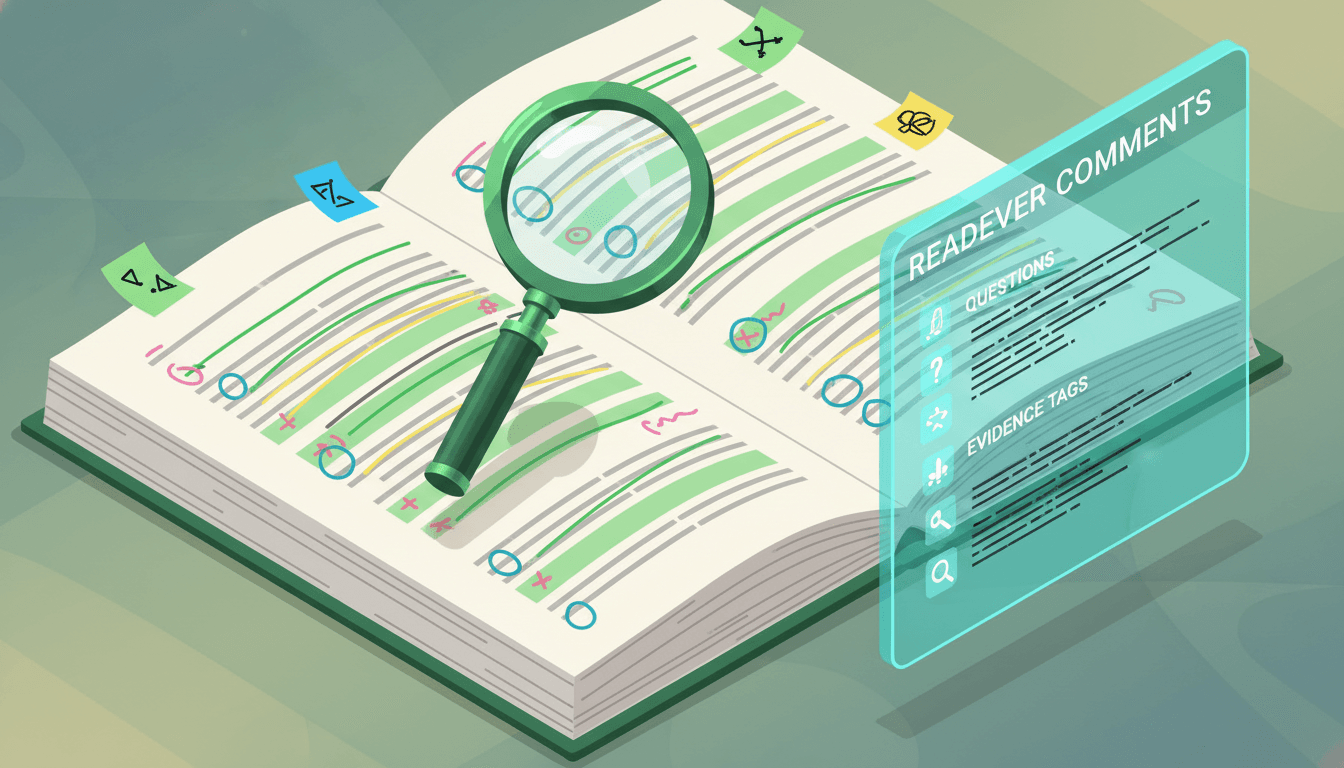
For a conversational way to test your understanding, talk to books and long-form texts can help you formulate questions. The source remains authoritative; verify names, numbers, methods, quotations, and references in the paper itself.
8. Adapt the template to different academic tasks
For a literature review, add fields for theme, agreement, disagreement, methodological contrast, and the gap the paper leaves. Do not build the review by stacking isolated summaries; compare papers around shared questions and explain why results differ.
For an annotated bibliography, keep the citation, compact description, evaluation, and relevance to your project. Follow the assignment’s required style and length rather than assuming one universal format.
For a methods library, expand materials, procedures, parameters, code, and reproducibility notes. For a seminar, emphasize the central claim, strongest evidence, major objection, and two discussion questions. For exam preparation, separate concepts worth recalling from evidence you need to interpret.
Readers exploring broader study workflows can browse education resources or return to the main Readever blog. Whatever version you use, preserve the same foundation: question, method, evidence, limits, and use.
9. Common summary mistakes to avoid
Retelling the introduction: Background may explain importance, but it is not the study’s evidence. Give the methods and findings proportional space.
Copying the abstract: This preserves the authors’ compression, not your understanding. Use the abstract to orient, then verify and rewrite.
Removing qualifiers: Words such as “may,” “in this sample,” and “under these assumptions” often carry essential boundaries. Do not make the claim cleaner by making it less accurate.
Listing results without design: A number is difficult to interpret without the comparison, measure, population, timing, and uncertainty.
Treating peer review as a verdict: Publication status is context, not a replacement for appraisal or comparison with other evidence.
Letting AI become the source: Generated summaries can help with orientation or questions, but they can omit details or introduce errors. Cite and check the original paper.
Frequently asked questions
How long should a research paper summary be?
Use the shortest length that preserves the question, essential methods, main evidence, limitations, and relevance to your task. A screening note may be a few paragraphs; a paper supporting consequential analysis may need a fuller evidence record. Assignment requirements take priority when applicable.
Should a research paper summary include methods?
Yes. At minimum, identify the design, population or data source, selection process, comparison, measures, and analysis features needed to interpret the finding. Without methods, a conclusion can appear broader or more certain than the study supports.
Can I use the abstract as my summary?
Use it as an orientation tool, not your final note. Verify important claims against the methods, results, figures, tables, limitations, and supplements, then write the summary in your own words.
What is the difference between a summary and a critical appraisal?
A summary records what the paper asked, did, found, and concluded. Critical appraisal additionally examines whether the design, conduct, analysis, reporting, and evidence justify the inference. A high-stakes use may require both.
How do I summarize a paper I do not fully understand?
Record what is clear, list the specific terms or methods you cannot evaluate, and seek an authoritative explanation or qualified review. Do not hide uncertainty. Return to the original section before retaining any generated explanation.
Can AI fill in a research paper summary template?
AI can help organize fields, surface passages, or propose questions, but its output should remain provisional. Verify every retained fact, number, quotation, method, limitation, and citation against the paper. Your summary should reflect your understanding and purpose.
Leave each paper with a verifiable evidence note
A dependable research paper summary keeps the study’s question, method, evidence, and boundaries together. Use the template consistently, but expand only the fields your decision requires. The result should help you return to the source, not make returning unnecessary.
Readever supports focused reading with contextual explanations, highlights, and questions beside the text. It does not replace the original paper or your judgment. Start a focused reading session with Readever.