A reading journal should help you stay close to a book and return to its ideas later. It should not turn every chapter into an assignment. The most useful journal captures just enough context to answer four questions: What did I read? What did I notice? What do I think? What should I revisit or do next?
The template below works for nonfiction, essays, academic books, memoir, history, and fiction. You can keep it in a paper notebook, document, notes app, or reading tool. Use the complete version for books that matter to a project or discussion, and the quick version for lighter reading.
Copy the fields you need and remove the rest. Consistency helps retrieval, but honest engagement matters more than filling every box.
1. Start with a simple book record
Begin each journal entry with enough source information to recognize the book and find the passage again. You do not need a formal citation unless your context requires one, but you do need an identifiable record.
Title:
Author:
Edition or translator, if relevant:
Format:
Date started:
Date finished or paused:
Why I chose this book:
What I hoped to learn, notice, or experience:
“Why I chose this book” is one of the most valuable fields. It separates an intentional reading choice from a title that simply appeared in a feed or list. Your answer may be practical—“understand a method for my project”—or personal—“see why this novel stayed with a friend.”
Add edition details when pagination, translation, introduction, or revisions affect what you are reading. If you later quote or discuss the text, the right edition and location will help you verify the passage.
Keep this opening short. Its job is orientation, not administration.
2. Set one reading question before you begin
A question gives attention a direction without forcing a conclusion. Before the first chapter, write one question you hope the book will help you explore.
Examples include:
- What problem does the author think is being misunderstood?
- Which assumptions hold the central argument together?
- How does the protagonist’s idea of responsibility change?
- What evidence would make me revise my current view?
- Which concept could be useful in my current project?
- What makes the writing persuasive, vivid, or difficult?
Your question can change. Record the revision rather than hiding it. A book may turn out to be about a different issue than its cover or introduction suggested, and a thoughtful journal should preserve that shift.
If you are reading for a class or group, add the shared prompt beside your own. This keeps assigned analysis and personal curiosity visible as separate purposes.
3. Use a lightweight entry for each reading session
Session entries preserve the path of your thinking. They are more useful when written regularly and briefly than when reconstructed from memory weeks later.
Date:
Pages or chapter:
One-sentence recap:
What held my attention:
A question or confusion:
A connection:
Passage to revisit + location:
Next reading intention:
The recap is not a full summary. Limit it to the change, claim, event, or tension you most need to remember. “The chapter contrasts prediction with explanation” gives your future self a better cue than a list of every subsection.
In “a connection,” name the relationship. The passage may support something you already believe, challenge another author, resemble a personal experience, illuminate a current project, or echo an earlier chapter. Write one sentence explaining how. Connections become useful when they carry meaning, not when they are only a title or tag.
If a session produces nothing worth preserving, record only the pages and a short reaction. The journal serves the reading; the reading does not owe the journal a fixed quantity of insight.
4. Annotate selectively and preserve context
A journal becomes harder to use when it reproduces the whole book. Capture fewer passages and add your reason for saving each one.
Use a simple three-part pattern:
Passage or concise paraphrase:
Location:
Why it matters to me:
The location may be a page, chapter, section, or digital locator. If exact wording matters, use quotation marks and transcribe carefully. If the idea matters more than the phrasing, paraphrase in your own words and label it as a paraphrase. In either case, retain enough context to distinguish what the author wrote from what you inferred.
Useful reasons include “defines the central term,” “contradicts chapter two,” “example for my presentation,” “beautiful shift in perspective,” or “claim I need to verify.” These notes protect a passage from becoming an isolated fragment.
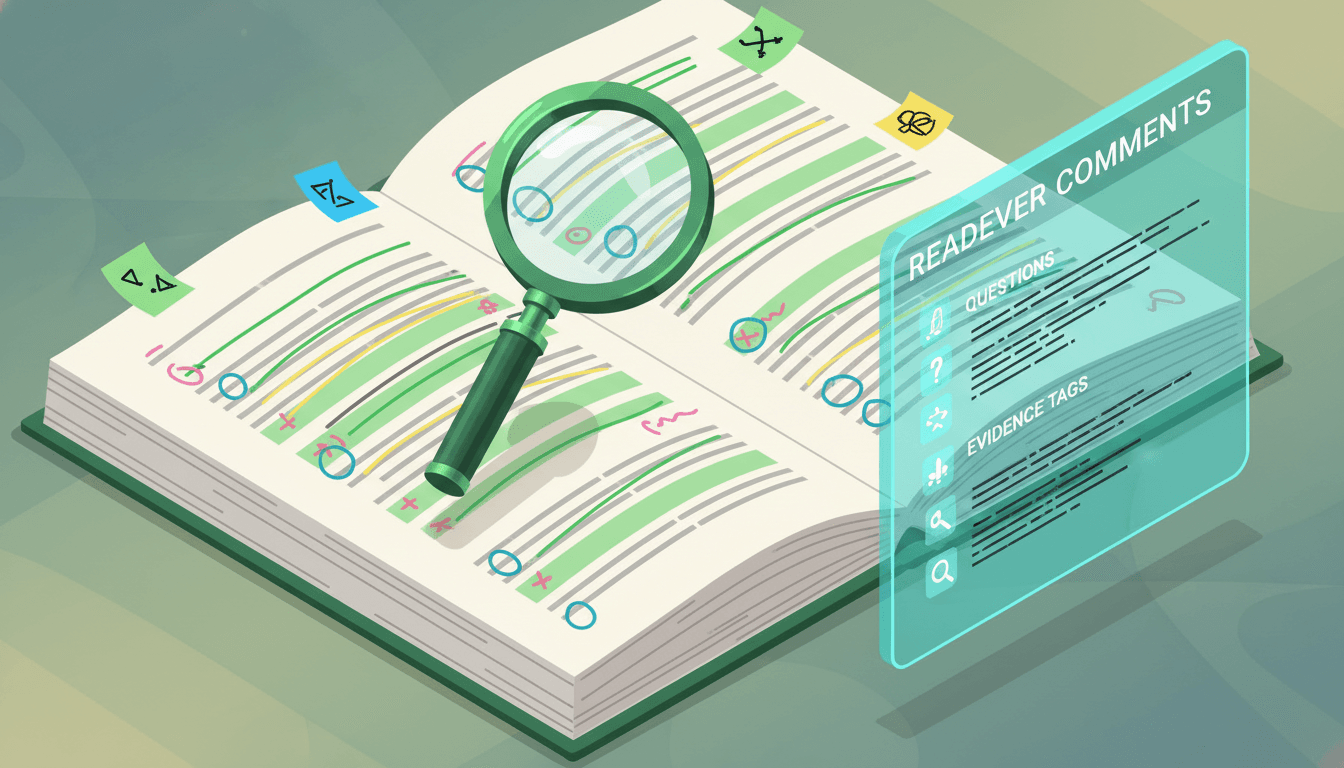
Readever’s AI book highlights can help you keep important passages visible while reading. Highlights and generated assistance are starting points, not a substitute for checking the surrounding text and writing your own response.
5. Add reflection prompts that fit the kind of book
Not every prompt suits every book. Choose two or three that create useful reflection rather than answering all of them mechanically.
For nonfiction:
- What is the author’s central claim in my own words?
- What evidence or reasoning does the claim depend on?
- Where are the limits, exceptions, or missing perspectives?
- Which idea changed or sharpened my understanding?
- What would I need to verify before applying this idea?
For fiction and memoir:
- What changed in a character’s desire, belief, or relationship?
- Which image, object, or setting keeps returning?
- Where did my sympathy shift, and why?
- What information is the narrator withholding or unable to see?
- Which scene changed the meaning of an earlier scene?
For any book:
- What surprised me?
- What did I resist?
- What remains unclear?
- What does this connect to?
- What is one question I would ask the author or a discussion group?
The journal is allowed to contain uncertainty. “I do not understand why this example proves the claim” is more useful than a confident summary that erases the gap.
6. Write a closing note instead of a generic rating
When you finish—or decide to stop—write a closing note while the shape of the book is still available to you.
The book in three sentences:
The question it answered best:
Its strongest idea, scene, or contribution:
A limitation, tension, or unresolved question:
What changed in my thinking or attention:
Who might value this book, and why:
What I want to revisit:
One next action:
If you use a rating, define what it represents. Enjoyment, craft, usefulness, evidence quality, and personal timing are not the same judgment. A single number can hide those differences. A short explanation such as “valuable framework, limited examples, worth revisiting for chapter four” gives you a better retrieval cue.
Stopping is a valid closing status. Record why: the book was outside your purpose, repeated material you already knew, required background you do not yet have, or was not right for the current moment. This turns an unfinished book into a considered decision rather than an invisible failure.
7. Create a one-page reading journal template
Use this complete version for a book you expect to discuss, apply, compare, or remember.
BOOK RECORD
Title:
Author:
Edition / translator:
Date started:
Date finished or paused:
Why I chose it:
My opening question:

DURING READING
Current chapter or pages:
One-sentence recap:
What held my attention:
Question or confusion:
Connection to another idea, book, experience, or project:
Passage or paraphrase to revisit:
Location:
Why it matters:

CLOSING REFLECTION
The book in three sentences:
Strongest idea, scene, or contribution:
Evidence, craft choice, or example that supports it:
Limitation, tension, or unresolved question:
What changed in my thinking or attention:
Who might value this book, and why:
What I want to revisit:
One next action:
Related books or notes:
For a five-minute version, keep only: title and author, why you chose it, one sentence about the book, one idea or scene, one question, and one next action. A small completed entry is better than an elaborate abandoned template.
8. Review the journal so ideas remain findable
A reading journal becomes more valuable when you revisit it. Once a week or after finishing a book, scan recent entries and mark the few ideas you want to carry forward.
Use three review actions:
- Clarify: Rewrite a vague entry so it makes sense without reopening the chapter.
- Connect: Link the idea to another book, question, or active project and explain the relationship.
- Act: Schedule a discussion, verify a claim, try a practice, choose the next book, or write a short synthesis.
Keep organization light. You might use broad labels such as history, leadership, fiction, or science, plus a status such as reading, finished, or paused. Searchable titles and specific language usually matter more than an elaborate taxonomy.
If you read primarily to learn from nonfiction, Readever’s non-fiction reading systems can support a repeatable path from key passages to questions and reflection. Your journal should still represent your own understanding, uncertainty, and decisions.
9. Adapt the template without losing its core
A student may add course, seminar question, key terms, and citation format. A book-club reader may add discussion prompts, disagreements, and members’ perspectives. A writer may track structure, voice, scene construction, and language. A professional may add decision relevance, evidence to verify, and possible experiments.
Whatever you add, preserve four core functions:
- identity: which book and edition;
- attention: what you noticed;
- interpretation: what you think it means;
- retrieval: how you will find and use it later.
Remove fields that repeatedly stay empty. Add a field only when you can describe the future decision or search it supports. The best template is not the longest one; it is the smallest structure that consistently improves your reading record.
Review your template after three books. If you cannot find the ideas you remember recording, improve titles or locators. If entries feel burdensome, reduce the session fields. If every closing note becomes a plot summary, add a prompt about tension, evidence, or changed understanding.
Frequently asked questions
What should be included in a reading journal?
Include the title and author, why you chose the book, a reading question, brief session notes, selected passages with locations, your reflections and connections, and a closing note with an unresolved question or next action.
Is a reading journal the same as a reading log?
Not usually. A reading log primarily records what and when you read. A reading journal adds questions, interpretations, passages, connections, and reflections. You can combine both in one entry.
How often should I write in a reading journal?
Write often enough to preserve useful context. A brief note after a chapter or reading session works well for many readers, but you can also write only when a question, connection, or passage is worth keeping.
Should I write a summary of every chapter?
No. Use a one-sentence recap when it helps you follow the book. Spend more space on ideas, scenes, questions, or changes that matter to your purpose.
Can I use this reading journal template for fiction?
Yes. For fiction, emphasize changes in character, recurring images, narrative perspective, important scenes, emotional shifts, and questions about form or meaning rather than forcing the book into an argument template.
Can AI fill out my reading journal for me?
AI can help surface passages or suggest questions, but a journal is valuable because it records your attention and interpretation. Check generated material against the book and write the final reflection in your own words.
Keep the record lighter than the reading
A reading journal succeeds when it helps you return to a book with context: why you opened it, what caught your attention, how your thinking moved, and what remains worth exploring. Begin with the one-page template, then shorten it until it fits your actual reading life.
Readever can support the reading process with contextual explanations, highlights, and book chat while you stay responsible for understanding the text and deciding what belongs in your journal. Start reading with Readever.
Browse more reading guides on the Readever blog or explore the personal development collection.