Assess data types, metadata, access, preservation, governance, and responsibilities before treating a data management plan as operational. For research data stewardship literacy, this guide keeps the original record, scope, and uncertainty visible. A reader learning how to read a data management plan can therefore verify the conclusion against the controlling evidence instead of trusting a compressed summary.
Prepare for how to read a data management plan: Open the Statistics Student Essentials bundle before this research data stewardship literacy reading. Keep those sources beside your how to read a data management plan notes so AI-assisted comparisons remain traceable.
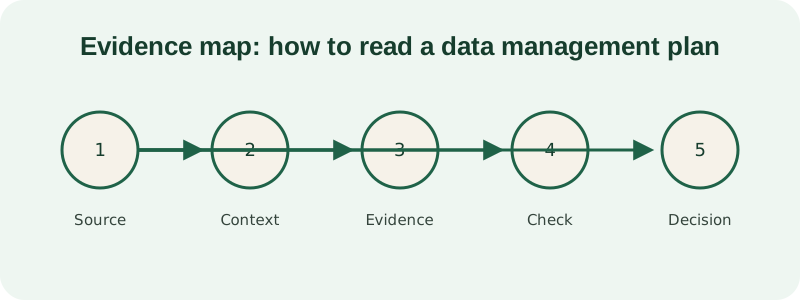
Define the data and research lifecycle
List expected data types, formats, volumes, collection methods, transformations, derived products, and retention stages. Distinguish raw, cleaned, analyzed, simulated, and published data. A plan should make clear which materials are covered and how decisions change from collection through preservation.
Inspect standards and metadata
Identify file formats, naming rules, schemas, codebooks, ontologies, units, identifiers, and version control. General promises to document data are not enough. Check whether metadata will let an independent researcher understand provenance, variables, processing, quality checks, and relationships among files.
Read access rules with exceptions
Separate public release, controlled access, embargo, contractual limits, intellectual property, confidentiality, and participant consent. Note who approves access and how requests are reviewed. A restriction should have a stated basis and duration rather than functioning as an undefined barrier to reuse.
Connect privacy to technical controls
Look for data minimization, de-identification, separation of identifiers, encryption, authentication, logging, secure transfer, and incident response. Confirm that protections match the sensitivity and threat model. Removing direct identifiers may not eliminate re-identification risk when detailed attributes can be combined.
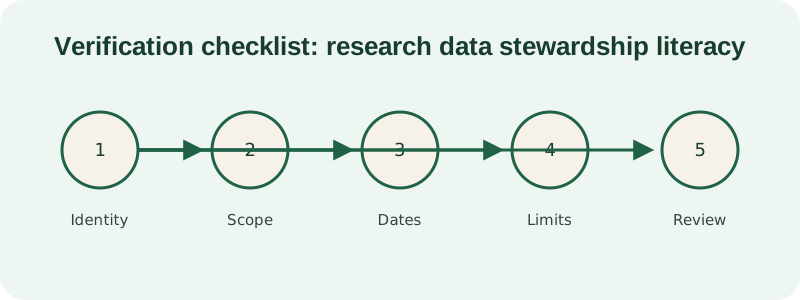
Midpoint check for research data stewardship literacy: Verify the identifiers, dates, definitions, and unresolved assumptions that govern this specific reading. For how to read a data management plan, re-open the controlling source whenever a summary and the record disagree.
Verify preservation and repository fit
Check repository selection, accepted formats, deposit timing, persistent identifiers, licensing, costs, retention, and succession arrangements. “Available on request” is not a preservation strategy. The chosen repository should support the data type, access model, metadata, and long-term responsibilities described in the plan.
Assign ownership and review points
Name responsible roles, milestones, training, budget, compliance checks, and plan-update triggers. Record how deviations will be approved and documented. A credible plan is a maintained operating agreement that can survive staff turnover, not a static paragraph written only for proposal submission.
Frequently Asked Questions
What should I verify first when learning how to read a data management plan?
Start with the record identity, scope, date, and controlling definitions for research data stewardship literacy; those fields determine whether later notes refer to the correct evidence.
Which source should anchor the first pass?
Use NIH guidance for writing a data management and sharing plan for orientation, then compare the relevant detail with NIH data management and sharing policy overview and preserve the exact locator used in your notes.
Can AI replace expert review for research data stewardship literacy?
No. AI can organize this material and surface conflicts, but consequential interpretations still require source verification and an accountable subject-matter reviewer.
What makes a research data stewardship literacy note reproducible?
For how to read a data management plan, record the source version and retrieval date. Add the exact research data stewardship literacy passage or field, unresolved limits, and reasoning that connects this evidence to the conclusion.
Put the Reading Into Practice
Open how to read a data management plan material in Readever and map the sections that control research data stewardship literacy. Attach each research data stewardship literacy claim to its exact passage; label interpretation separately for how to read a data management plan, preserve unresolved questions, and name the authoritative source or qualified reviewer needed for resolution.
Apply the workflow now: Build one Readever notebook for how to read a data management plan, link each claim to its source, and route consequential uncertainty to an accountable reviewer.
Related Readever Pages
-
Continue with 6 Steps to Read a Federal Register Notice in 2026
-
Explore the AI reading assistant for research data stewardship literacy
-
Build a nonfiction reading system for research data stewardship literacy
-
Practice critical reading for research data stewardship literacy