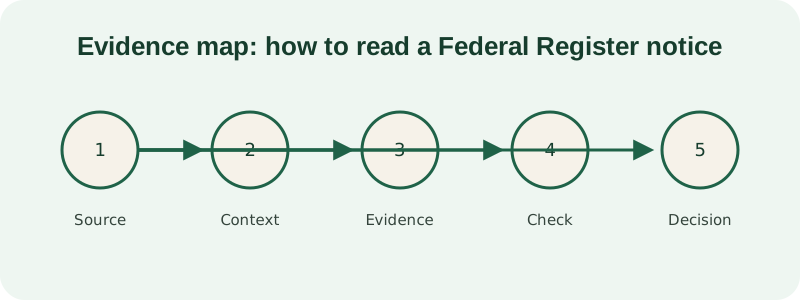
Locate agency action, legal authority, dates, docket material, participation instructions, and current status in a Federal Register notice. For federal regulatory literacy, this guide keeps the original record, scope, and uncertainty visible. A reader learning how to read a Federal Register notice can therefore verify the conclusion against the controlling evidence instead of trusting a compressed summary.
Prepare for how to read a Federal Register notice: Open the Nonprofit Impact and Leadership bundle before this federal regulatory literacy reading. Keep those sources beside your how to read a Federal Register notice notes so AI-assisted comparisons remain traceable.
Identify the document type and agency
Confirm whether the notice is a proposed rule, final rule, notice, correction, request for information, meeting announcement, or other action. Record the issuing agency and any joint issuers. Different document types carry different procedural meaning and should not be summarized as if each creates a binding rule.
Read the summary and dates together
Extract publication, effective, compliance, hearing, meeting, and comment deadlines. Determine the time zone and submission cut-off. Corrections and extensions may change earlier dates, so search the document history and docket before treating the first notice as current.
Find the authority and action boundary
Locate statutory and regulatory authority, affected provisions, definitions, and the precise action being taken. Separate background explanation from operative text. If the notice references another rule, order, or guidance document, open it rather than inferring its requirements from a short description.
Use the docket as the evidence trail
Record the docket number, regulation identifier, related documents, supporting analyses, comments, and contact information. Docket material may contain methods, data, and stakeholder arguments not reproduced in the notice. Note confidentiality claims, unavailable attachments, and later additions.
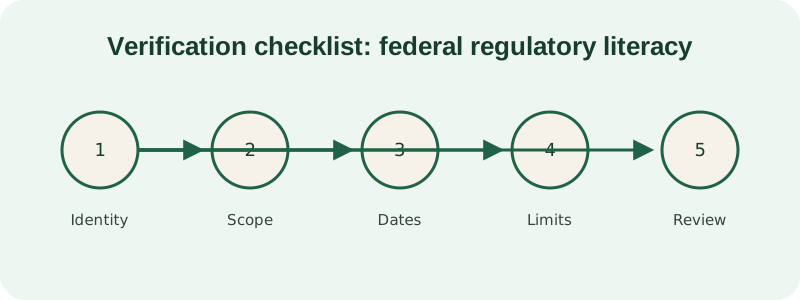
Midpoint check for federal regulatory literacy: Verify the identifiers, dates, definitions, and unresolved assumptions that govern this specific reading. For how to read a Federal Register notice, re-open the controlling source whenever a summary and the record disagree.
Follow participation instructions exactly
Check accepted submission methods, required identifiers, formatting, privacy warnings, and procedures for meetings or accommodations. Submit comments to the specified docket rather than a general agency address. A strong comment distinguishes evidence, experience, legal argument, and requested change.
Verify status before relying on the notice
Check for withdrawal, delay, correction, finalization, litigation, or superseding action. Save the citation, publication date, document number, page range, and date verified. A notice can remain historically important while no longer representing the agency’s current operative position.
Frequently Asked Questions
What should I verify first when learning how to read a Federal Register notice?
Start with the record identity, scope, date, and controlling definitions for federal regulatory literacy; those fields determine whether later notes refer to the correct evidence.
Which source should anchor the first pass?
Use GovInfo guide to the Federal Register for orientation, then compare the relevant detail with National Archives overview of the Federal Register and preserve the exact locator used in your notes.
Can AI replace expert review for federal regulatory literacy?
No. AI can organize this material and surface conflicts, but consequential interpretations still require source verification and an accountable subject-matter reviewer.
What makes a federal regulatory literacy note reproducible?
For how to read a Federal Register notice, record the source version and retrieval date. Add the exact federal regulatory literacy passage or field, unresolved limits, and reasoning that connects this evidence to the conclusion.
Put the Reading Into Practice
Open how to read a Federal Register notice material in Readever and map the sections that control federal regulatory literacy. Attach each federal regulatory literacy claim to its exact passage; label interpretation separately for how to read a Federal Register notice, preserve unresolved questions, and name the authoritative source or qualified reviewer needed for resolution.
Apply the workflow now: Build one Readever notebook for how to read a Federal Register notice, link each claim to its source, and route consequential uncertainty to an accountable reviewer.
Related Readever Pages
-
Continue with 6 Steps to Read a National Register Nomination in 2026
-
Explore the AI reading assistant for federal regulatory literacy
-
Build a nonfiction reading system for federal regulatory literacy