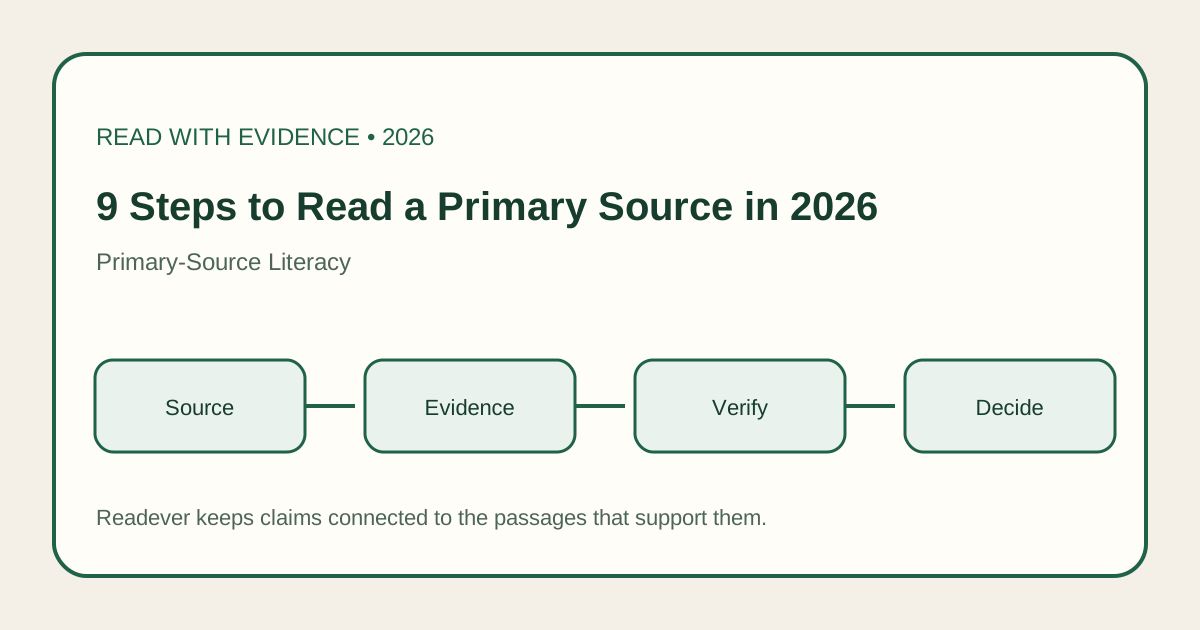
Evaluate provenance, audience, purpose, omissions, physical features, and corroborating records before using a primary source as evidence. For primary-source literacy, this guide keeps the original record, scope, and uncertainty visible. A reader learning how to read a primary source can therefore verify the conclusion against the controlling evidence instead of trusting a compressed summary.
Prepare for how to read a primary source: Open the Journalism Sourcecraft bundle before this primary-source literacy reading. Keep those sources beside your how to read a primary source notes so AI-assisted comparisons remain traceable.
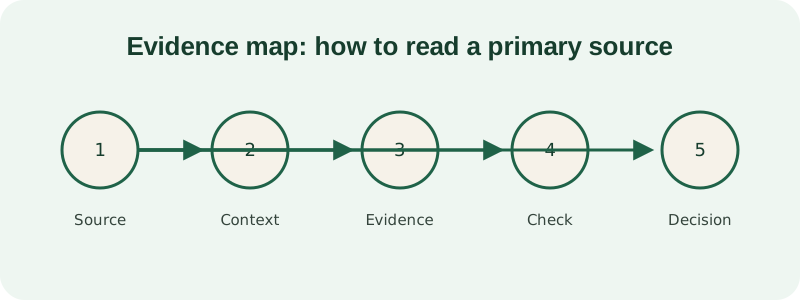
Identify the object before interpreting it
Record the creator, date, format, collection, repository, identifier, and whether you are viewing an original, scan, transcription, excerpt, or later reproduction. Note missing pages, illegible text, editorial annotations, and translation choices. These details establish what evidence is actually available and what may have changed through mediation.
Reconstruct the production context
Ask who commissioned, created, preserved, and cataloged the item. Identify the event, institution, technology, or administrative process that produced it. A diary, government form, photograph, speech, ledger, and newspaper advertisement each carry different conventions and constraints that shape what can reasonably be inferred.
Separate audience from later readership
Determine the intended recipient or public, the expected circulation, and any reason for secrecy or performance. Language aimed at a supervisor, voter, family member, customer, or court may emphasize different facts. Do not assume the creator expected the source to be archived or read by people outside its original setting.
Observe before explaining
List visible words, structure, marks, images, corrections, stamps, and absences before assigning meaning. Distinguish direct observation from interpretation. If handwriting, cropping, damage, or unfamiliar terminology creates uncertainty, record alternative readings instead of silently choosing the most convenient one.
Midpoint check for primary-source literacy: Verify the identifiers, dates, definitions, and unresolved assumptions that govern this specific reading. For how to read a primary source, re-open the controlling source whenever a summary and the record disagree.
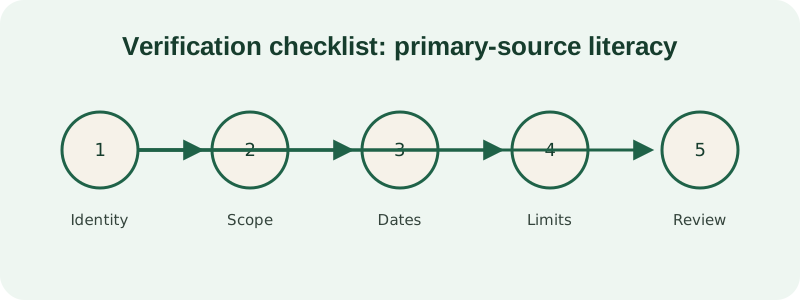
Test claims against other records
Corroborate dates, identities, places, quantities, and disputed events with independent sources. Look for records created by people with different roles or incentives. Agreement can strengthen a claim, while disagreement may reveal perspective, memory limits, institutional conflict, or changes over time.
Write a bounded conclusion
State what the source supports, what it suggests, and what it cannot establish alone. Preserve quotations sparingly with exact locations and contextual notes. An auditable reading includes the source identifier, interpretive steps, competing evidence, unresolved ambiguity, and the reason the conclusion remains proportionate.
Frequently Asked Questions
What should I verify first when learning how to read a primary source?
Start with the record identity, scope, date, and controlling definitions for primary-source literacy; those fields determine whether later notes refer to the correct evidence.
Which source should anchor the first pass?
Use National Archives document analysis worksheets for orientation, then compare the relevant detail with National Archives guidance on primary sources and preserve the exact locator used in your notes.
Can AI replace expert review for primary-source literacy?
No. AI can organize this material and surface conflicts, but consequential interpretations still require source verification and an accountable subject-matter reviewer.
What makes a primary-source literacy note reproducible?
For how to read a primary source, record the source version and retrieval date. Add the exact primary-source literacy passage or field, unresolved limits, and reasoning that connects this evidence to the conclusion.
Put the Reading Into Practice
Open how to read a primary source material in Readever and map the sections that control primary-source literacy. Attach each primary-source literacy claim to its exact passage; label interpretation separately for how to read a primary source, preserve unresolved questions, and name the authoritative source or qualified reviewer needed for resolution.
Apply the workflow now: Build one Readever notebook for how to read a primary source, link each claim to its source, and route consequential uncertainty to an accountable reviewer.
Related Readever Pages
-
Continue with 6 Steps to Read a Product Recall Notice in 2026
-
Explore the AI reading assistant for primary-source literacy
-
Build a nonfiction reading system for primary-source literacy