Move through a scientific poster by question, methods, results, uncertainty, and limitations instead of following visual prominence alone. For scientific communication literacy, this guide keeps the original record, scope, and uncertainty visible. A reader learning how to read a scientific poster can therefore verify the conclusion against the controlling evidence instead of trusting a compressed summary.
Prepare for how to read a scientific poster: Open the Statistics Student Essentials bundle before this scientific communication literacy reading. Keep those sources beside your how to read a scientific poster notes so AI-assisted comparisons remain traceable.
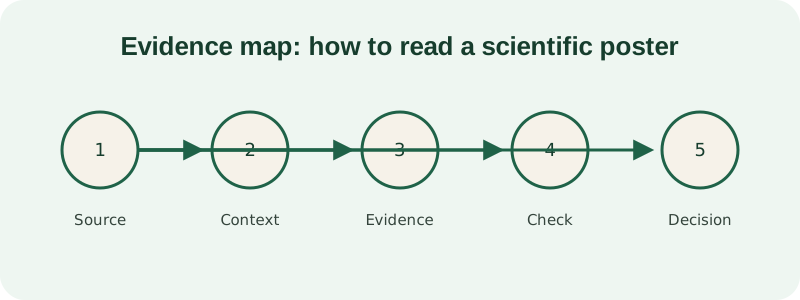
Start with the research question
Identify the population, system, intervention or exposure, comparison, outcome, and stated objective. Rewrite the question in one sentence. This prevents a striking graphic or broad title from substituting for the actual claim the study was designed to test.
Check the study design and sample
Find recruitment, inclusion criteria, controls, randomization or matching, sample size, setting, and timing. Note whether the poster reports completed work, interim analysis, a pilot, or a proposal. Small captions may contain exclusions or denominators that materially change how the results should be read.
Trace each figure to its method
For every plot or image, identify the measured variable, units, axis scale, normalization, statistical method, and missing-data handling. Confirm that colors and symbols refer to the groups described in the legend. Decorative emphasis and large visual area do not establish evidentiary importance.
Read uncertainty, not only direction
Look for confidence intervals, variation, effect sizes, sensitivity analysis, multiple comparisons, and practical magnitude. A statistically notable result can still be fragile or operationally small. If uncertainty is absent, record that omission instead of treating the point estimate as precise.
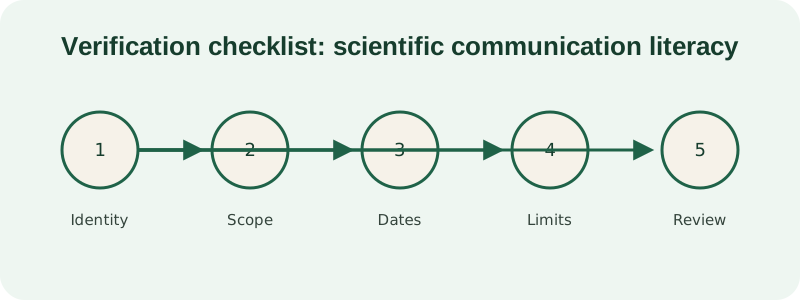
Midpoint check for scientific communication literacy: Verify the identifiers, dates, definitions, and unresolved assumptions that govern this specific reading. For how to read a scientific poster, re-open the controlling source whenever a summary and the record disagree.
Compare conclusions with displayed results
Underline each conclusion and link it to a table, figure, or stated analysis. Check for causal wording in observational work, subgroup claims unsupported by design, or generalization beyond the sample. Posters compress detail, so missing methods should become questions for the author rather than assumptions.
Capture questions for follow-up
Record the poster identifier, conference, version, presenter, and any related paper or protocol. Ask about exclusions, preprocessing, preregistration, negative results, and data availability. A useful poster note separates what is visible, what the presenter clarified, and what still requires a citable source.
Frequently Asked Questions
What should I verify first when learning how to read a scientific poster?
Start with the record identity, scope, date, and controlling definitions for scientific communication literacy; those fields determine whether later notes refer to the correct evidence.
Which source should anchor the first pass?
Use NIH guidance for creating a scientific poster for orientation, then compare the relevant detail with NIH checklist for communicating research and preserve the exact locator used in your notes.
Can AI replace expert review for scientific communication literacy?
No. AI can organize this material and surface conflicts, but consequential interpretations still require source verification and an accountable subject-matter reviewer.
What makes a scientific communication literacy note reproducible?
For how to read a scientific poster, record the source version and retrieval date. Add the exact scientific communication literacy passage or field, unresolved limits, and reasoning that connects this evidence to the conclusion.
Put the Reading Into Practice
Open how to read a scientific poster material in Readever and map the sections that control scientific communication literacy. Attach each scientific communication literacy claim to its exact passage; label interpretation separately for how to read a scientific poster, preserve unresolved questions, and name the authoritative source or qualified reviewer needed for resolution.
Apply the workflow now: Build one Readever notebook for how to read a scientific poster, link each claim to its source, and route consequential uncertainty to an accountable reviewer.
Related Readever Pages
-
Explore the AI reading assistant for scientific communication literacy
-
Build a nonfiction reading system for scientific communication literacy
-
Practice critical reading for scientific communication literacy