Read cover pages, business context, risk factors, financial statements, exhibits, and filing history without treating a single metric as the whole company. For securities disclosure literacy, this guide keeps the original record, scope, and uncertainty visible. A reader learning how to read an SEC filing can therefore verify the conclusion against the controlling evidence instead of trusting a compressed summary.
Prepare for how to read an SEC filing: Open the Public Company Evidence bundle before this securities disclosure literacy reading. Keep those sources beside your how to read an SEC filing notes so AI-assisted comparisons remain traceable.
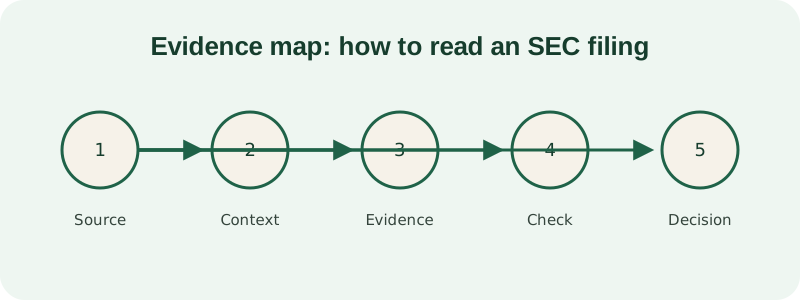
Confirm the form, filer, and reporting period
Start with the form type, accession date, company identity, fiscal period, and amendment status. A 10-K, 10-Q, 8-K, registration statement, and proxy statement answer different questions. Check whether the filing is original or amended, consolidated or subsidiary-specific, and whether incorporated material lives in another document before drawing conclusions.
Map the business before the numbers
Read the business description, segments, customers, suppliers, seasonality, geography, competition, and stated strategy. Record how management says money is earned and where important dependencies sit. This map helps distinguish an operational change from an accounting presentation change when you reach the financial statements.
Read risk factors as scoped claims
Group risks by demand, financing, regulation, technology, cybersecurity, concentration, litigation, and execution. Compare wording with prior filings to identify additions, removals, and changed emphasis. Risk sections are not predictions; they are disclosures shaped by materiality judgments, legal drafting, and the company’s current circumstances.
Reconcile statements with footnotes
Trace revenue, margins, cash flow, debt, equity, and major noncash items into the notes. Check accounting policies, estimates, segment definitions, commitments, contingencies, related-party transactions, and subsequent events. A headline number can be technically correct while hiding a change in classification, timing, or assumptions.
Midpoint check for securities disclosure literacy: Verify the identifiers, dates, definitions, and unresolved assumptions that govern this specific reading. For how to read an SEC filing, re-open the controlling source whenever a summary and the record disagree.
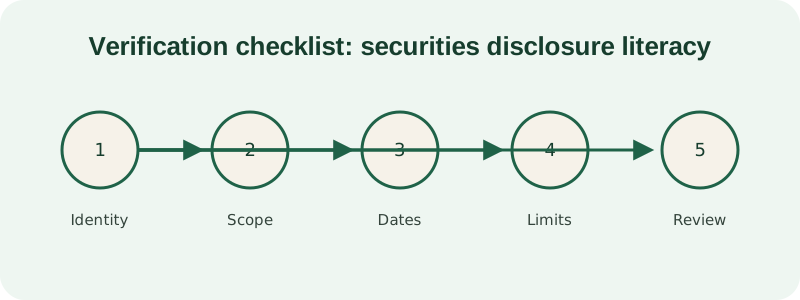
Use MD&A to test the explanation
Compare management’s discussion with the statements and footnotes. Separate volume, price, mix, currency, acquisition, and one-time effects. Mark forward-looking language and non-GAAP measures, then find the reconciliation and rationale. Ask whether the explanation accounts for the size and direction of the reported change.
Follow exhibits and filing history
Open material contracts, certifications, press releases, and referenced exhibits when they carry the evidence behind a claim. Review nearby filings for amendments or event updates. Save accession numbers, dates, page locations, and unresolved discrepancies so another reader can reproduce the analysis.
Frequently Asked Questions
What should I verify first when learning how to read an SEC filing?
Start with the record identity, scope, date, and controlling definitions for securities disclosure literacy; those fields determine whether later notes refer to the correct evidence.
Which source should anchor the first pass?
Use SEC Search Filings for orientation, then compare the relevant detail with SEC guidance for accessing EDGAR data and preserve the exact locator used in your notes.
Can AI replace expert review for securities disclosure literacy?
No. AI can organize this material and surface conflicts, but consequential interpretations still require source verification and an accountable subject-matter reviewer.
What makes a securities disclosure literacy note reproducible?
For how to read an SEC filing, record the source version and retrieval date. Add the exact securities disclosure literacy passage or field, unresolved limits, and reasoning that connects this evidence to the conclusion.
Put the Reading Into Practice
Open how to read an SEC filing material in Readever and map the sections that control securities disclosure literacy. Attach each securities disclosure literacy claim to its exact passage; label interpretation separately for how to read an SEC filing, preserve unresolved questions, and name the authoritative source or qualified reviewer needed for resolution.
Apply the workflow now: Build one Readever notebook for how to read an SEC filing, link each claim to its source, and route consequential uncertainty to an accountable reviewer.
Related Readever Pages
-
Continue with 6 AI Reading Steps for Chemistry Students in 2026
-
Explore the AI reading assistant for securities disclosure literacy
-
Build a nonfiction reading system for securities disclosure literacy
-
Practice critical reading for securities disclosure literacy