Organize chemical records, methods, spectra, safety documents, and reactions while preserving identifiers, conditions, uncertainty, and hazard context. For chemistry education, this guide keeps the original record, scope, and uncertainty visible. A reader learning AI reading assistant for chemistry students can therefore verify the conclusion against the controlling evidence instead of trusting a compressed summary.
Prepare for AI reading assistant for chemistry students: Open the Safety and Failure Prevention bundle before this chemistry education reading. Keep those sources beside your AI reading assistant for chemistry students notes so AI-assisted comparisons remain traceable.
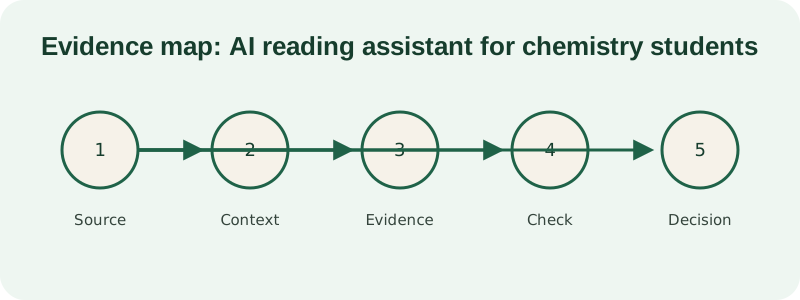
Anchor every compound to identifiers
Keep names, structures, formulas, stereochemistry, salts, isotopes, and database identifiers together. Common names can refer to mixtures or different forms. When an assistant merges records, verify the exact substance and source record before transferring properties, hazards, or reaction behavior.
Separate measured from predicted properties
Label whether a value is experimental, calculated, curated, vendor-supplied, or predicted. Preserve units, temperature, pressure, solvent, pH, method, and uncertainty. Values that appear comparable may come from incompatible conditions, and an unqualified average can erase the context required for laboratory decisions.
Map reaction conditions completely
Capture stoichiometry, concentrations, order of addition, atmosphere, temperature profile, time, workup, purification, yield basis, and scale. Distinguish a proposed mechanism from direct observation. AI can organize procedural variants, but it should not fill omitted conditions or convert a literature example into an unsupervised operating instruction.
Read spectra with assignment discipline
Link peaks, integrations, multiplicities, ranges, baselines, and instrument settings to the claimed structure. Preserve ambiguous or overlapping signals. Compare spectra with the exact sample form and purity information, and note when a figure is illustrative rather than sufficient for independent identification.
Midpoint check for chemistry education: Verify the identifiers, dates, definitions, and unresolved assumptions that govern this specific reading. For AI reading assistant for chemistry students, re-open the controlling source whenever a summary and the record disagree.
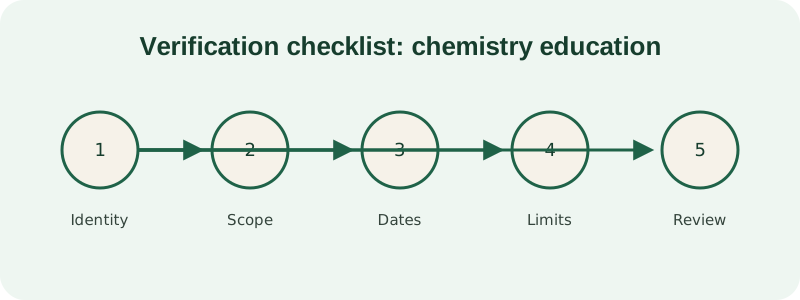
Keep hazard evidence attached
Read safety data, incompatibilities, exposure routes, storage requirements, waste guidance, and emergency controls alongside the chemical record. Hazard language varies by jurisdiction and use. Do not infer that missing classification means safe, and do not let a concise summary replace institutional procedures or qualified supervision.
Build a reproducible evidence trail
Save database versions, record URLs, article citations, page or figure locations, and transformation steps. Mark contradictions among sources and the rationale for choosing one value. A strong chemistry note lets another reader identify the substance, conditions, evidence type, and limits without depending on hidden model reasoning.
Frequently Asked Questions
What should I verify first when learning AI reading assistant for chemistry students?
Start with the record identity, scope, date, and controlling definitions for chemistry education; those fields determine whether later notes refer to the correct evidence.
Which source should anchor the first pass?
Use PubChem chemical information resource for orientation, then compare the relevant detail with OSHA safety data sheet publications and preserve the exact locator used in your notes.
Can AI replace expert review for chemistry education?
No. AI can organize this material and surface conflicts, but consequential interpretations still require source verification and an accountable subject-matter reviewer.
What makes a chemistry education note reproducible?
For AI reading assistant for chemistry students, record the source version and retrieval date. Add the exact chemistry education passage or field, unresolved limits, and reasoning that connects this evidence to the conclusion.
Put the Reading Into Practice
Open AI reading assistant for chemistry students material in Readever and map the sections that control chemistry education. Attach each chemistry education claim to its exact passage; label interpretation separately for AI reading assistant for chemistry students, preserve unresolved questions, and name the authoritative source or qualified reviewer needed for resolution.
Apply the workflow now: Build one Readever notebook for AI reading assistant for chemistry students, link each claim to its source, and route consequential uncertainty to an accountable reviewer.