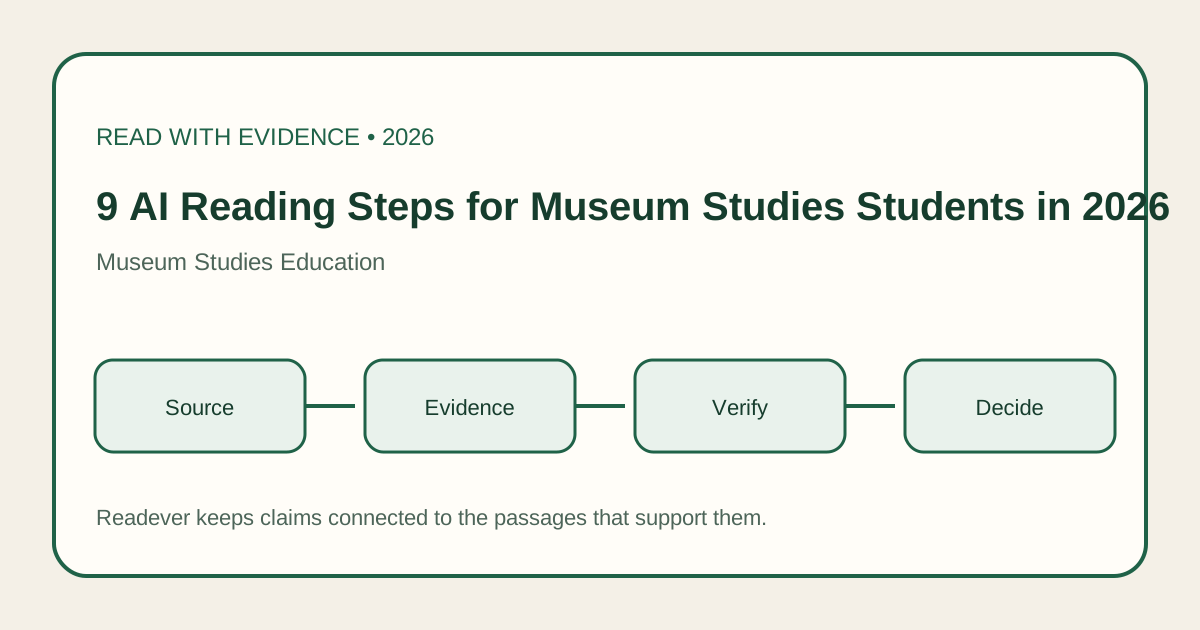
Compare catalog records, object histories, exhibit labels, conservation notes, and interpretive claims with AI while preserving provenance and uncertainty. For museum studies education, this guide keeps the original record, scope, and uncertainty visible. A reader learning AI reading assistant for museum studies students can therefore verify the conclusion against the controlling evidence instead of trusting a compressed summary.
Prepare for AI reading assistant for museum studies students: Open the Conservation Evidence bundle before this museum studies education reading. Keep those sources beside your AI reading assistant for museum studies students notes so AI-assisted comparisons remain traceable.
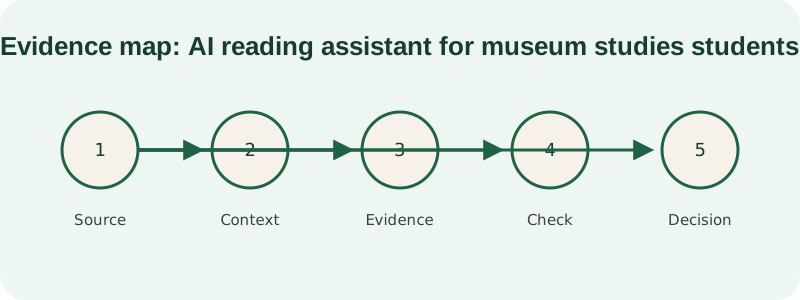
Begin with the object record
Capture accession number, object name, maker or culture, date range, materials, dimensions, condition, ownership history, and restrictions. Treat catalog fields as claims with sources and revision histories, not timeless facts. Differences among records may reflect new research, changed terminology, or unresolved attribution.
Distinguish description from interpretation
Separate observable physical features from statements about meaning, use, identity, or significance. Exhibit labels often compress scholarly debate for a particular audience. Keep alternate attributions, contested terms, and uncertainty visible when comparing a label with catalog, conservation, or research documentation.
Trace provenance and custody
Build a dated chain of ownership, excavation, transfer, loan, and institutional custody. Mark gaps, ambiguous names, incomplete documentation, and changes in legal or ethical standards. AI can align names and dates, but provenance conclusions require source-level verification and should not erase uncertainty.
Read display as an argument
Examine selection, grouping, sequence, lighting, scale, placement, and neighboring objects. Ask whose perspective organizes the exhibit and what is excluded. A display creates relationships that may not exist in the original context, so record the difference between curatorial framing and evidence about the object itself.
Midpoint check for museum studies education: Verify the identifiers, dates, definitions, and unresolved assumptions that govern this specific reading. For AI reading assistant for museum studies students, re-open the controlling source whenever a summary and the record disagree.
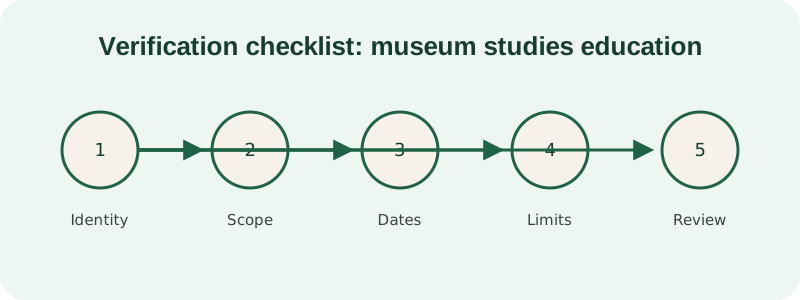
Connect conservation to interpretation
Review material condition, repairs, replacements, environmental limits, treatment history, and display constraints. Conservation decisions can affect appearance and the confidence of visual conclusions. Preserve technical terminology and distinguish preventive care from restoration, reconstruction, or speculative completion.
Create a transparent interpretive note
Link every consequential statement to an object record, archival source, publication, or qualified observation. Label community knowledge and consultation appropriately. Record terminology decisions, rights or access limits, unresolved conflicts, and the audience for the interpretation so future revisions remain accountable.
Frequently Asked Questions
What should I verify first when learning AI reading assistant for museum studies students?
Start with the record identity, scope, date, and controlling definitions for museum studies education; those fields determine whether later notes refer to the correct evidence.
Which source should anchor the first pass?
Use NPS guidance on using objects in exhibits for orientation, then compare the relevant detail with NPS Museum Handbook Part III and preserve the exact locator used in your notes.
Can AI replace expert review for museum studies education?
No. AI can organize this material and surface conflicts, but consequential interpretations still require source verification and an accountable subject-matter reviewer.
What makes a museum studies education note reproducible?
For AI reading assistant for museum studies students, record the source version and retrieval date. Add the exact museum studies education passage or field, unresolved limits, and reasoning that connects this evidence to the conclusion.
Put the Reading Into Practice
Open AI reading assistant for museum studies students material in Readever and map the sections that control museum studies education. Attach each museum studies education claim to its exact passage; label interpretation separately for AI reading assistant for museum studies students, preserve unresolved questions, and name the authoritative source or qualified reviewer needed for resolution.
Apply the workflow now: Build one Readever notebook for AI reading assistant for museum studies students, link each claim to its source, and route consequential uncertainty to an accountable reviewer.
Related Readever Pages
-
Continue with 6 AI Reading Steps for Policy Analysis Students in 2026
-
Explore the AI reading assistant for museum studies education
-
Build a nonfiction reading system for museum studies education