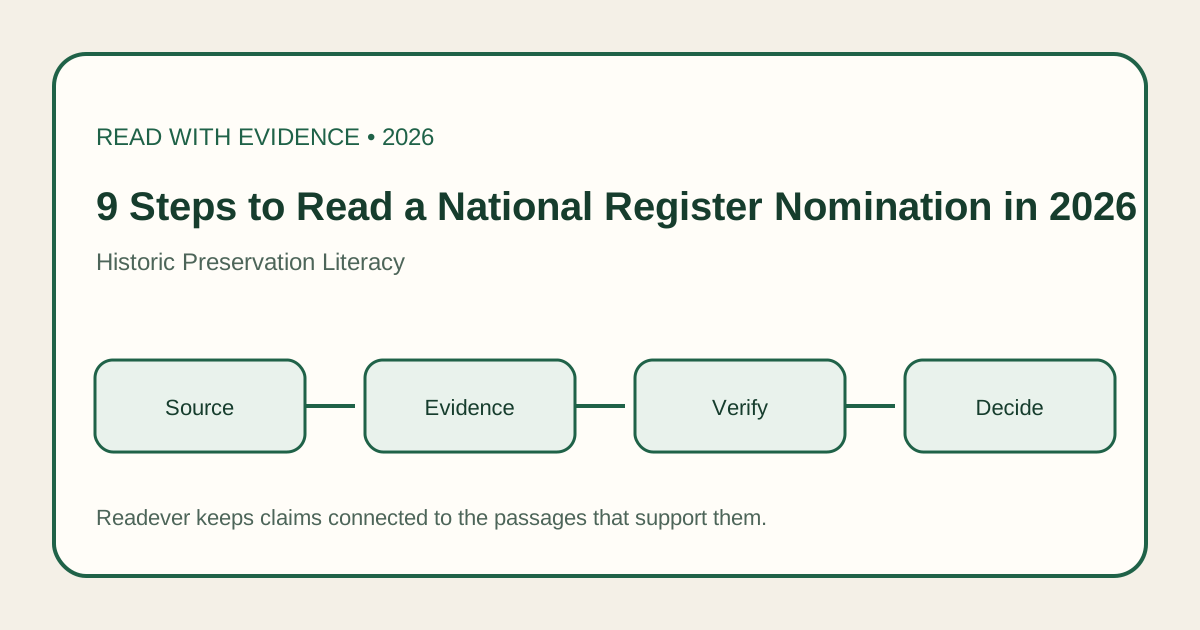
Read significance, boundaries, integrity, chronology, maps, photographs, and bibliography as a documented argument rather than a simple property description. For historic preservation literacy, this guide keeps the original record, scope, and uncertainty visible. A reader learning how to read a National Register nomination can therefore verify the conclusion against the controlling evidence instead of trusting a compressed summary.
Prepare for how to read a National Register nomination: Open the Conservation Evidence bundle before this historic preservation literacy reading. Keep those sources beside your how to read a National Register nomination notes so AI-assisted comparisons remain traceable.
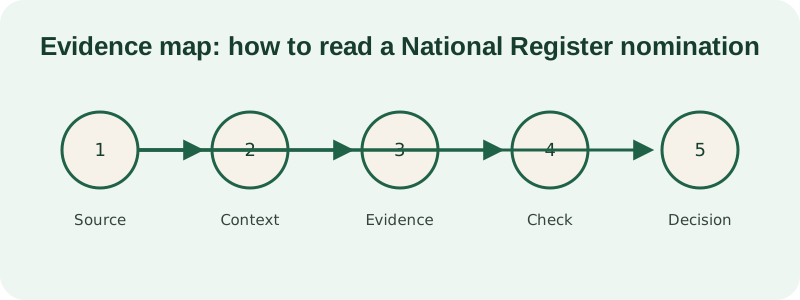
Confirm the property and nomination version
Record the property name, location, reference number, nomination date, listed date, amendments, and boundary changes. Determine whether the file covers an individual property, district, multiple-property submission, or later documentation update. Use the final signed form and attached continuation sheets together.
Understand the classification and boundaries
Identify contributing and noncontributing resources, ownership, acreage, boundary justification, and map references. District names or modern parcels may not match the nominated boundary. Check whether buildings, structures, sites, objects, landscape features, and archaeological resources are counted separately.
Read significance through criteria
Locate the period of significance, areas of significance, applicable criteria, level of significance, and any exceptions. Connect each claimed association or design quality to dated evidence. A nomination is an argument for eligibility under defined standards, not a general assertion that a place is old or valued.
Test integrity against physical evidence
Review location, design, setting, materials, workmanship, feeling, and association in relation to the stated significance. Note alterations, relocation, deterioration, reconstruction, and incompatible additions. Integrity is contextual: a change may matter differently for architecture, social history, archaeology, or an evolving cultural landscape.
Midpoint check for historic preservation literacy: Verify the identifiers, dates, definitions, and unresolved assumptions that govern this specific reading. For how to read a National Register nomination, re-open the controlling source whenever a summary and the record disagree.
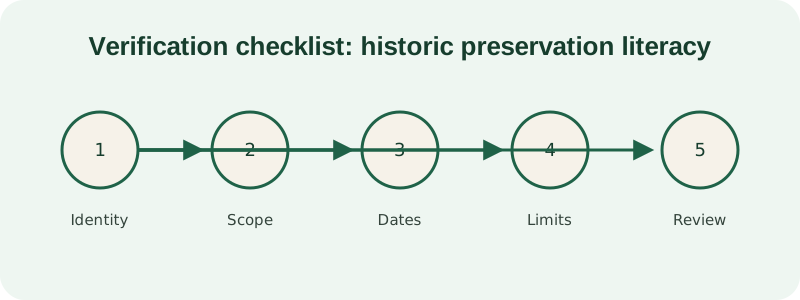
Reconstruct chronology and sources
Build a timeline of construction, use, ownership, alteration, events, and research. Compare narrative statements with deeds, maps, directories, photographs, plans, oral histories, and prior surveys. Mark estimates and disputed dates, and distinguish evidence contemporary to the event from later recollection.
Use maps, photographs, and bibliography together
Match photo numbers and map labels to resource descriptions and boundaries. Check direction, date, and vantage point. Follow the bibliography to the underlying record when a consequential claim is compressed. An auditable note identifies which part of the nomination supports each conclusion and what remains uncertain.
Frequently Asked Questions
What should I verify first when learning how to read a National Register nomination?
Start with the record identity, scope, date, and controlling definitions for historic preservation literacy; those fields determine whether later notes refer to the correct evidence.
Which source should anchor the first pass?
Use National Register publications and guidance for orientation, then compare the relevant detail with NPS guidance on listing a property and preserve the exact locator used in your notes.
Can AI replace expert review for historic preservation literacy?
No. AI can organize this material and surface conflicts, but consequential interpretations still require source verification and an accountable subject-matter reviewer.
What makes a historic preservation literacy note reproducible?
For how to read a National Register nomination, record the source version and retrieval date. Add the exact historic preservation literacy passage or field, unresolved limits, and reasoning that connects this evidence to the conclusion.
Put the Reading Into Practice
Open how to read a National Register nomination material in Readever and map the sections that control historic preservation literacy. Attach each historic preservation literacy claim to its exact passage; label interpretation separately for how to read a National Register nomination, preserve unresolved questions, and name the authoritative source or qualified reviewer needed for resolution.
Apply the workflow now: Build one Readever notebook for how to read a National Register nomination, link each claim to its source, and route consequential uncertainty to an accountable reviewer.
Related Readever Pages
-
Explore the AI reading assistant for historic preservation literacy
-
Build a nonfiction reading system for historic preservation literacy
-
Practice critical reading for historic preservation literacy