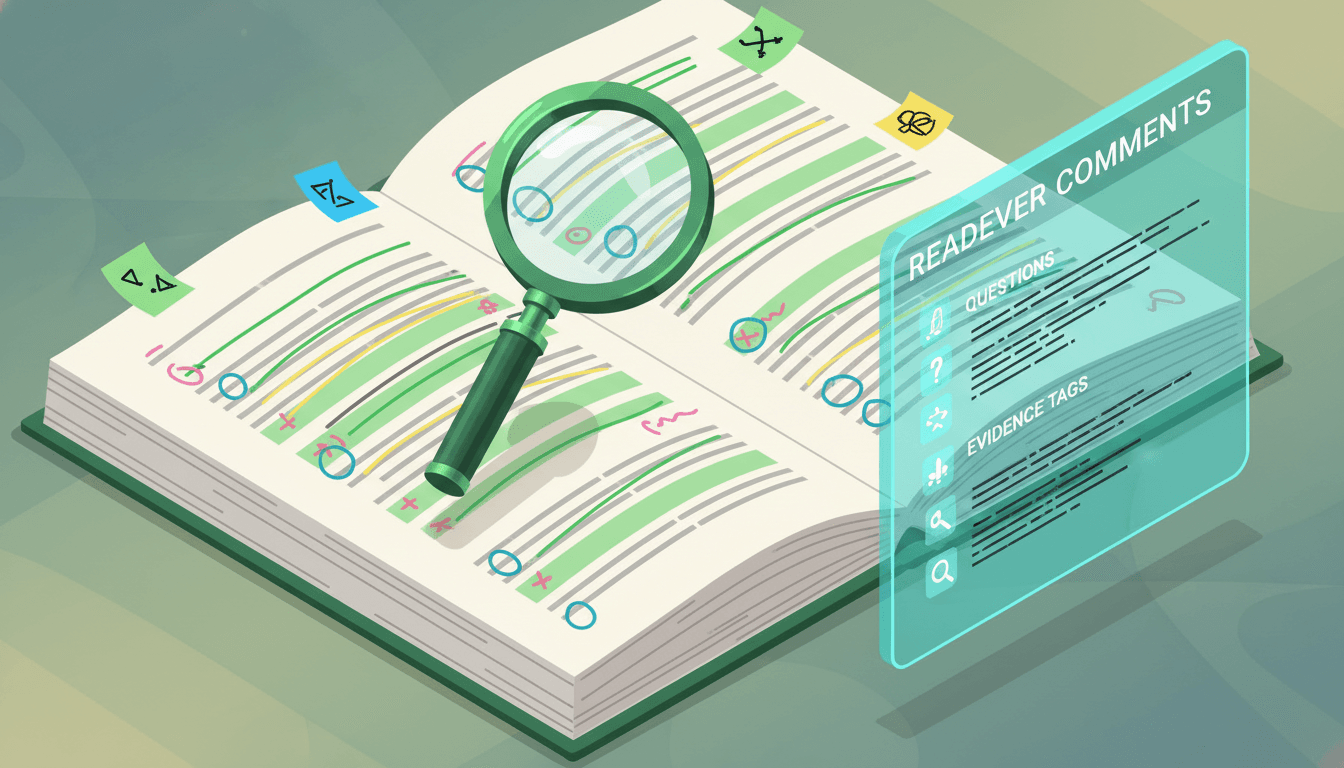
A folder full of PDFs is not a research system. It may preserve files, but it does not reliably tell you why you saved a paper, what evidence it contains, how it relates to other sources, or where it belongs in your current work. The result is familiar: duplicate downloads, mysterious filenames, highlights without context, and repeated searches for a paper you know you have seen.
A useful system joins two layers. The library layer preserves source identity, files, and bibliographic details. The thinking layer records your questions, interpretations, evidence checks, and connections. Keeping those layers linked lets you retrieve a paper by author or title while also finding it through the problem it helped you investigate.
The workflow below is tool-neutral. You can use a citation manager, folders, a notes app, or a combination. The goal is not a perfect archive. It is a dependable path from discovery to a traceable note you can use in a paper, project, class, or decision.
1. Define what your research system must retrieve
Start with retrieval, not categories. Imagine three realistic situations: you need the strongest evidence for a claim, you need to compare methods across studies, or you need to find the source behind a sentence in an old draft. What information would help you locate and evaluate the right paper?
For most research collections, the minimum useful record includes:
- title, authors, year, and publication;
- a persistent identifier or stable source URL when available;
- the local file or full-text location;
- the question that led you to save it;
- study or argument type;
- a brief statement of the main claim;
- your note on relevance, limitations, and possible use;
- links to related sources, topics, or projects.
Write a one-sentence purpose for the collection, such as: “This library supports my thesis on how remote work affects early-career learning.” A purpose makes organization easier because it creates a standard for what belongs. You can maintain separate collections for unrelated domains while using the same record structure in each.
Do not make “save everything” the purpose. A smaller library with clear reasons for inclusion is often easier to search and maintain than a large archive of unexamined downloads.
2. Choose one source of truth for bibliographic records
Pick one place where the authoritative source record lives. A citation manager is designed for this role, but a carefully maintained database can work. The key is to avoid competing versions of the same citation across folders, documents, and note apps.
When you add a paper, check the imported metadata against the paper itself. Confirm the title, author order, year, journal or venue, volume and issue when relevant, and identifier. Automated imports can be incomplete, especially for preprints, conference proceedings, scanned documents, or records captured from an index page.
Keep the attached file with that record or store a stable pointer to it. If you rename PDFs outside your reference tool, use a consistent, readable rule such as FirstAuthor-Year-ShortTitle.pdf. Filenames are a fallback for browsing and recovery, not a substitute for complete metadata.
Deduplicate early. Before importing another copy, search by title, DOI, or a distinctive title phrase. If two versions matter—for example, a preprint and a later journal article—keep both only when the distinction serves your work, and label the relationship clearly.
3. Use broad collections and a small controlled tag set
Folders and collections answer “where am I working?” Tags answer “what is this about or what role does it play?” Use each for the job it handles well.
Create a shallow collection structure. A practical starting point is:
- Inbox for newly saved, unchecked items;
- Active projects for sources tied to current work;
- Topics for a few durable research areas;
- Methods if method comparison is central to your field;
- Archive for completed or inactive work.
Avoid building several nested levels before the collection demands them. A paper can often belong to more than one topic or project, so forcing it into one deep folder hides useful overlap.
Keep tags controlled. Decide on a small vocabulary for recurring concepts and workflow states. For example, use method-qualitative, method-experiment, and method-review rather than accumulating accidental variants such as “qual,” “qualitative study,” and “interviews.” Workflow tags such as to-read, read, verify, or cited can be useful when their meanings are explicit.
Do not tag every noun in the abstract. Add a tag only if you expect to search, filter, compare, or review it later.
4. Process every saved paper through an inbox
An inbox prevents unreviewed papers from disappearing into the main library. Every new item enters the inbox, then earns a destination through a short processing pass.
For each item:
- Correct the bibliographic metadata.
- Confirm that the file opens and is the intended version.
- Record the question or search that led you to it.
- Scan the abstract, headings, figures, conclusion, and limitations for relevance.
- Decide: delete, defer, or read.
- Assign a project or topic collection and only the necessary tags.
- Create or link the source note.
Deletion is part of organization. Remove accidental duplicates, irrelevant results, and files you cannot identify. If a paper looks useful later but not now, defer it with a reason, not just a generic unread status: “background for measurement section” is more actionable than “maybe.”
Schedule a small recurring inbox review. The frequency matters less than the rule that the inbox is temporary. If it becomes a second permanent library, it stops protecting the rest of the system.
5. Give each important paper one structured source note
A source note should answer what the paper is, what it says, how you evaluated it, and why it matters to your work. Keep it linked directly to the bibliographic record so that interpretation never loses its source.
Use this compact structure:
- Citation / record link:
- My research question:
- Paper’s question or objective:
- Design, data, or argumentative approach:
- Main reported claim:
- Evidence or reasoning supporting it:
- Key limitations and uncertainties:
- Important definitions or terms:
- My interpretation:
- Potential use:
- Related papers or notes:
- Page, section, figure, or table locators:
Separate the authors’ report from your interpretation. “The study reports an association” and “this may support my mechanism” are different statements. Keep both, but label them. When exact language matters, preserve a short quotation with a locator; otherwise paraphrase in your own words and retain enough context to verify it.
Readever’s AI reading assistant can help you ask questions beside difficult material and surface relevant passages. Treat those outputs as navigation and explanation support. Verify every claim, number, citation, population, and limitation against the original paper before it enters your research record.
6. Connect papers through claims, not vague similarity
A useful research library shows relationships. Instead of linking two papers only because both concern “motivation,” state what the relationship is.
Use connection labels such as:
- Supports: reports evidence consistent with the same claim;
- Challenges: produces a conflicting result or critique;
- Extends: tests the question in a different population, setting, or period;
- Uses method from: adapts a design, measure, dataset, or framework;
- Defines differently: uses a term in a way that changes comparison;
- Cites / is cited by: provides a traceable scholarly relationship;
- Needed for: contributes to a specific section, argument, or decision.
Write one sentence explaining each meaningful connection. “Uses the same scale but samples a different age group” is more useful than an unexplained backlink. These relationship notes make later synthesis easier because they preserve the reason you grouped sources.
When several papers gather around one question, create a synthesis note. List agreements, contradictions, methodological differences, open questions, and the strength of evidence you currently see. This is not yet a literature review draft; it is a navigational map of your collection.
7. Organize notes around questions and projects
Topic labels are useful, but active questions are better retrieval hooks. “Employee learning” may contain hundreds of items. “Which remote-work conditions reduce informal learning for new hires?” gives you a sharper filter and suggests what evidence to compare.
Create a project hub for each substantial output. Include the central question, scope, subquestions, search terms tried, inclusion rules, key sources, unresolved disputes, and links to draft sections. Let papers appear in multiple hubs when they genuinely support different projects; do not duplicate the underlying source record.
Within a project, group notes by function rather than reading order:
- definitions and background;
- mechanisms or theories;
- supporting evidence;
- counterevidence and boundary conditions;
- methods and measures;
- implications;
- gaps and next searches.
This arrangement keeps the collection aligned with reasoning. Readever’s non-fiction reading systems can support the reading stage by helping you keep high-signal ideas and questions near the text, but your project hub should preserve your own judgments and source trail.
8. Review, back up, and test retrieval
Organization must survive beyond the week you build it. Use a short weekly review to empty the inbox, finish source notes for high-value papers, resolve duplicates, and attach useful material to active projects. Use a deeper project review to compare sources and update synthesis notes.
Test the system with real retrieval prompts:
- Find the strongest source for a claim without browsing every PDF.
- Find all studies using a particular method or measure.
- Recover the page or figure behind a saved observation.
- Identify papers that disagree and explain why.
- Trace a statement in your draft back to its source record.
When a test fails, fix the smallest cause. Improve a title, add a missing locator, merge a duplicate tag, or link a note to the right project. Do not redesign the entire system whenever one item is hard to find.
Maintain backups and an export path appropriate to your tools and institution. A research system is more durable when its records and notes can be recovered in common formats. Before sharing or publishing, verify citations against the original sources and follow any field, institution, journal, or funder requirements that apply.
Frequently asked questions
What is the best way to organize research papers?
Use one authoritative bibliographic library, a shallow set of collections, a controlled tag vocabulary, and a linked source note for each important paper. Organize active work around research questions and projects rather than relying only on subject folders.
Should I organize research papers by topic or by project?
Use both when useful. Topics support long-term browsing, while project collections gather sources for a current output. Keep one underlying source record and allow it to appear in multiple collections instead of duplicating the paper.
How should I name research paper PDF files?
Use a consistent, readable fallback such as FirstAuthor-Year-ShortTitle.pdf. Complete and verified bibliographic metadata should remain the main way you identify the paper; filenames alone cannot preserve all source details.
How many tags should I add to each paper?
There is no ideal number. Add only tags you expect to use for search, filtering, comparison, or workflow. A small controlled vocabulary is more dependable than many overlapping variants.
Where should I keep notes about a research paper?
Keep one structured source note linked to the paper’s bibliographic record. It should distinguish the authors’ claims from your interpretation and retain page, section, figure, or table locators for verification.
Can AI organize research papers and notes for me?
AI can assist with navigation, candidate labels, or questions, but it can misclassify sources or omit important context. You should verify metadata and evidence against the original paper and make the final decisions about relevance, tags, claims, and connections.
Build a library you can reason with
Good organization is not measured by folder symmetry or the number of saved PDFs. It is measured by whether you can recover a source, understand why it mattered, check the underlying evidence, and connect it to the question in front of you.
Start with one inbox, one source of truth, and one source-note template. Process the next five papers, then test whether you can retrieve them by claim, method, and project. Readever can support focused reading with contextual explanations and questions beside the text while you remain responsible for interpretation and verification. Start reading with Readever.
For more research-oriented reading, browse the Readever blog or explore the education collection.