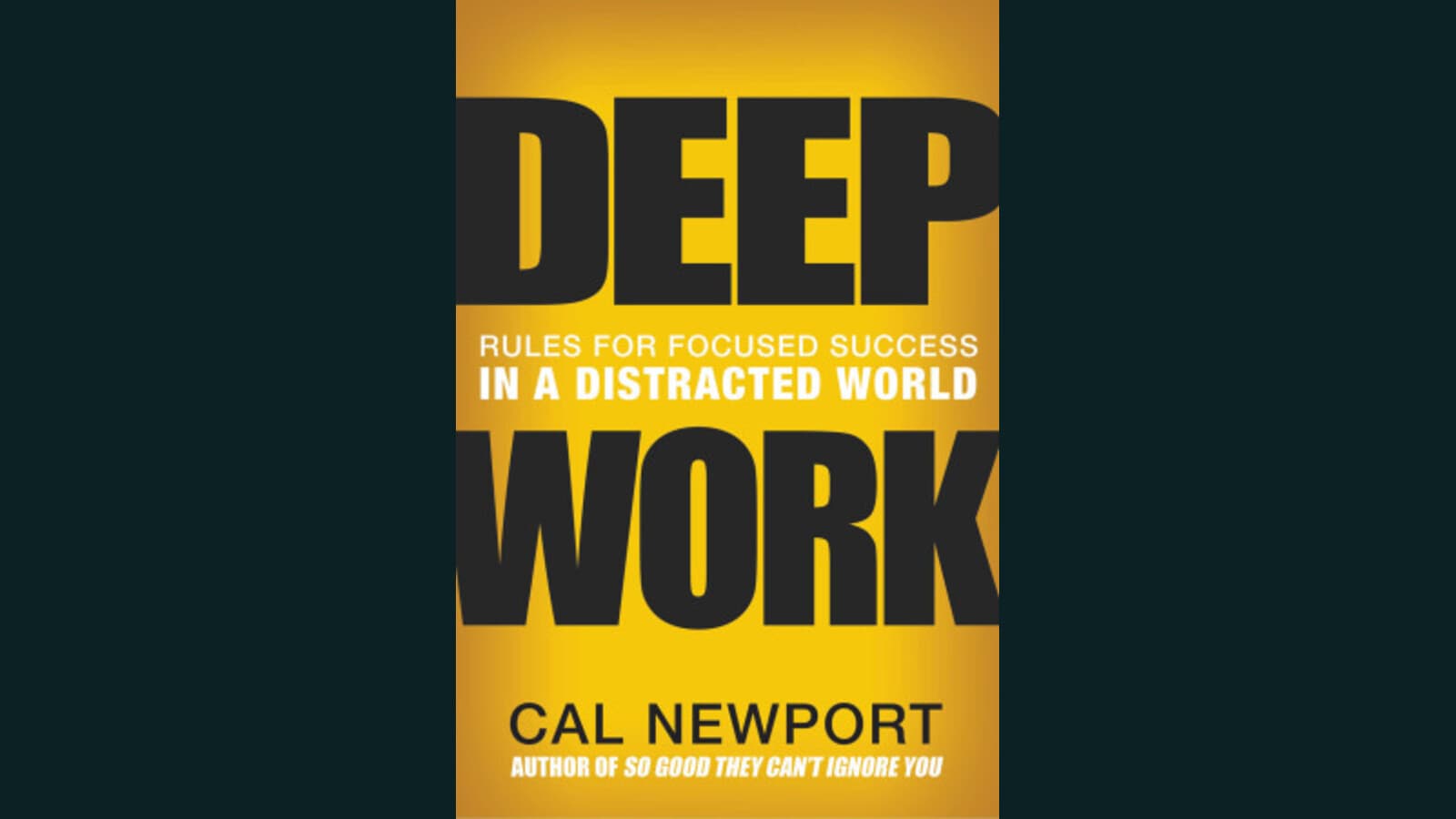
Cal Newport’s Deep Work argues that sustained, cognitively demanding work is valuable and increasingly difficult in environments built around interruption. The book combines a case for focused work with rules for practicing it. A useful reading approach should do the same: evaluate the argument, observe your own attention, and test a schedule that respects the realities of your role.
This guide provides a three-week plan, an attention audit, and questions for deciding which recommendations are practical for you. It does not reproduce the book or promise that one routine will fit every job.
Before You Read: Define “Deep” for Your Work
“Focused work” looks different for a software engineer, teacher, designer, manager, student, or caregiver. Choose one output that requires sustained thought and that you can recognize when complete. Examples include drafting a proposal, analyzing a dataset, planning a lesson, studying a difficult concept, or revising a chapter.
Write down:
- the output you want to advance;
- the kind of thinking it requires;
- the minimum useful focus period;
- the people, tools, or information you need;
- the communication obligations you cannot simply remove.
This keeps the book’s argument connected to a real responsibility rather than an idealized image of concentration.
How the Book Is Organized
The first part makes the case that concentrated work creates value, develops skill, and can make work more satisfying. The second part turns to practice through four broad rules: create conditions for depth, become more comfortable without constant stimulation, use digital tools deliberately, and reduce low-value administrative work.
Read the two parts with different questions. In the argument section, ask whether the evidence and examples transfer to your field. In the practice section, ask what constraint each recommendation addresses and what less extreme version might work in your context.
The Core Ideas to Track
Focus Is a Designed Condition
Concentration is not only a matter of motivation. Time, location, access rules, rituals, and expectations shape whether attention can remain on one task. Notice which examples rely on control over a schedule and which could work in collaborative settings.
Attention Has Switching Costs
Moving repeatedly between a demanding task and messages can leave part of your attention attached to the previous activity. While reading, observe how often you switch and what triggers it. The goal is not to condemn communication; it is to make its cost visible.
Boredom and Stimulation Matter
The book connects constant novelty with difficulty sustaining attention. You do not need to adopt an all-or-nothing digital detox to test this idea. A short period without automatic checking can reveal how quickly the urge to switch appears.
Tools Should Serve Chosen Values
Instead of asking whether a platform offers any benefit, the book encourages a more selective question: does it substantially support the activities that matter most? Apply this to one tool at a time and account for professional, social, and accessibility needs.
Shallow Work Is Not Always Useless
Email, coordination, forms, and routine tasks often keep organizations functioning. The useful distinction is not “important people focus; everyone else answers messages.” It is whether the amount and timing of low-intensity work crowd out the outcomes your role actually requires.
A Three-Week Deep Work Reading Plan
Week 1: Read the Case and Audit Your Attention
Read Part 1: The Idea. Then begin Rule #1: Work Deeply in Part 2. For five ordinary workdays, keep a lightweight log. Record when you begin a cognitively demanding task, when you switch away, why you switched, and whether the interruption was necessary.
At the end of the week, group interruptions into four types:
- externally urgent;
- externally expected but schedulable;
- self-initiated tool checking;
- task avoidance caused by uncertainty or difficulty.
Different causes need different solutions. Muting notifications will not fix an unclear task, and better planning will not remove an emergency duty.
Week 2: Test One Focus Ritual
Continue Rule #1: Work Deeply and read Rule #2: Embrace Boredom. These named rules are stable across common editions even when pagination varies. Design one repeatable block with:
- a start time or trigger;
- one defined outcome;
- a location;
- a communication rule;
- the materials prepared in advance;
- a clear stopping point.
Test the block three times. Start with a duration you can protect honestly, even if it is only 25 or 45 minutes. Measure whether you began, whether you protected the block, and what output moved forward. Do not use hours alone as a proxy for quality.
Week 3: Review Tools and Contain Shallow Work
Read Rule #3: Quit Social Media and Rule #4: Drain the Shallows. Treat the headings as prompts for selective tool review and workload design, not commands that fit every role. Select one recurring source of fragmentation. Decide whether to remove it, restrict it to a window, delegate it, automate it, or accept it as necessary.
Then create a weekly plan that includes both focus blocks and communication windows. Share relevant availability expectations with collaborators. A private plan that conflicts with team norms will be fragile.
Attention Audit Template
Completed example: A product manager switches from drafting a launch decision to answer a customer-severity message. If the message reports an active outage, classify it as externally urgent. If it is a routine status request expected by end of day, classify it as externally expected but schedulable and move it to a communication window. If the manager opened chat without a notification, it is self-initiated checking. If they checked because the decision criteria were unclear, the underlying cause is task ambiguity, so muting alerts alone will not solve it.
| Question | Observation |
|---|---|
| What high-value output needs uninterrupted thought? | |
| When is my attention usually strongest? | |
| What triggers most switches? | |
| Which interruptions are genuinely time-sensitive? | |
| Which communication windows are realistic? | |
| What ritual will mark the beginning of a focus block? | |
| How will I define completion? | |
| What will I change after three trials? |
Build a Focus System, Not a Perfect Day
A resilient focus system includes recovery. Meetings move, children need attention, customers escalate problems, and energy varies. Use three levels:
- Full block: your preferred duration and setup.
- Reduced block: a shorter version for crowded days.
- Restart action: the smallest step that makes tomorrow’s return easier, such as leaving a next-action note.
This avoids the common pattern in which one disrupted morning causes the entire plan to be abandoned.
Questions to Ask While Reading
- Which parts of Newport’s argument depend on knowledge-work autonomy?
- What valuable work in my role is collaborative, responsive, or relational rather than solitary?
- Is distraction the real problem, or is the task poorly defined?
- Which communication expectations are explicit, and which am I assuming?
- What would colleagues need to know before I change my availability?
- Which digital tool delivers a benefit I could not obtain another way?
- What evidence would show that a focus routine improves output rather than merely feeling disciplined?
Common Misreadings to Avoid
Deep Work Means Being Unreachable
Focused time needs boundaries, but many roles require responsiveness. The practical task is to establish predictable windows and escalation paths, not to disappear without coordination.
More Hours Always Produce More Value
Cognitive energy is limited, and output quality matters. A shorter, well-defined block can outperform a long session divided among unclear tasks.
Every Digital Tool Is the Enemy
The book’s stronger question is whether a tool supports your most important activities enough to justify its costs. Evaluate tools by function and context, not by category alone.
A Focus Ritual Can Fix Workload Problems
Concentration practices cannot resolve understaffing, impossible deadlines, discriminatory expectations, or chronic overwork. Those require organizational decisions, resources, and boundaries beyond personal productivity techniques.
Discussion and Journal Prompts
- What is the clearest example of deep work in your week? What makes it difficult to start?
- Which shallow task is necessary but poorly timed?
- When does responsiveness create genuine value in your role?
- What would a fair team norm for focus and availability look like?
- Which tool would you keep after a strict cost-benefit review, and why?
- How would you measure the result of a focus experiment without glorifying overwork?
Read Deep Work With Readever
Open Deep Work on Readever. Use smart highlights to mark claims you want to test, contextual explanations when the book introduces unfamiliar research, and Book Chat to challenge whether an example fits your work.
Continue with the productivity collection, compare its systems lens with Essentialism, browse the book-guide hub, or learn about Readever’s AI reading assistant.
Frequently Asked Questions
How long should a deep-work session be?
There is no universal duration. Choose the shortest block that can advance a meaningful output, protect it reliably, and expand only when your task and energy support a longer session.
How do I use the book when my job includes on-call or rapid-response duties?
Define protected work around the duty rather than pretending the duty does not exist. Keep an explicit escalation channel, classify what is truly urgent, and use reduced focus blocks during coverage periods.
What if I cannot control my meeting calendar?
Track the fragments that remain, protect one realistic block where possible, and bring evidence about switching costs into a team conversation. Individual rituals cannot replace organizational changes when the calendar is structurally overloaded.
Should I read the book in order?
First-time readers should read the argument before the rules so they can evaluate the rationale. Returning readers can revisit the rule that addresses their current bottleneck.
Is this guide a summary of Deep Work?
No. It is a reading and application companion. It outlines the book’s structure and supplies original exercises, but it does not reproduce the full argument or examples.