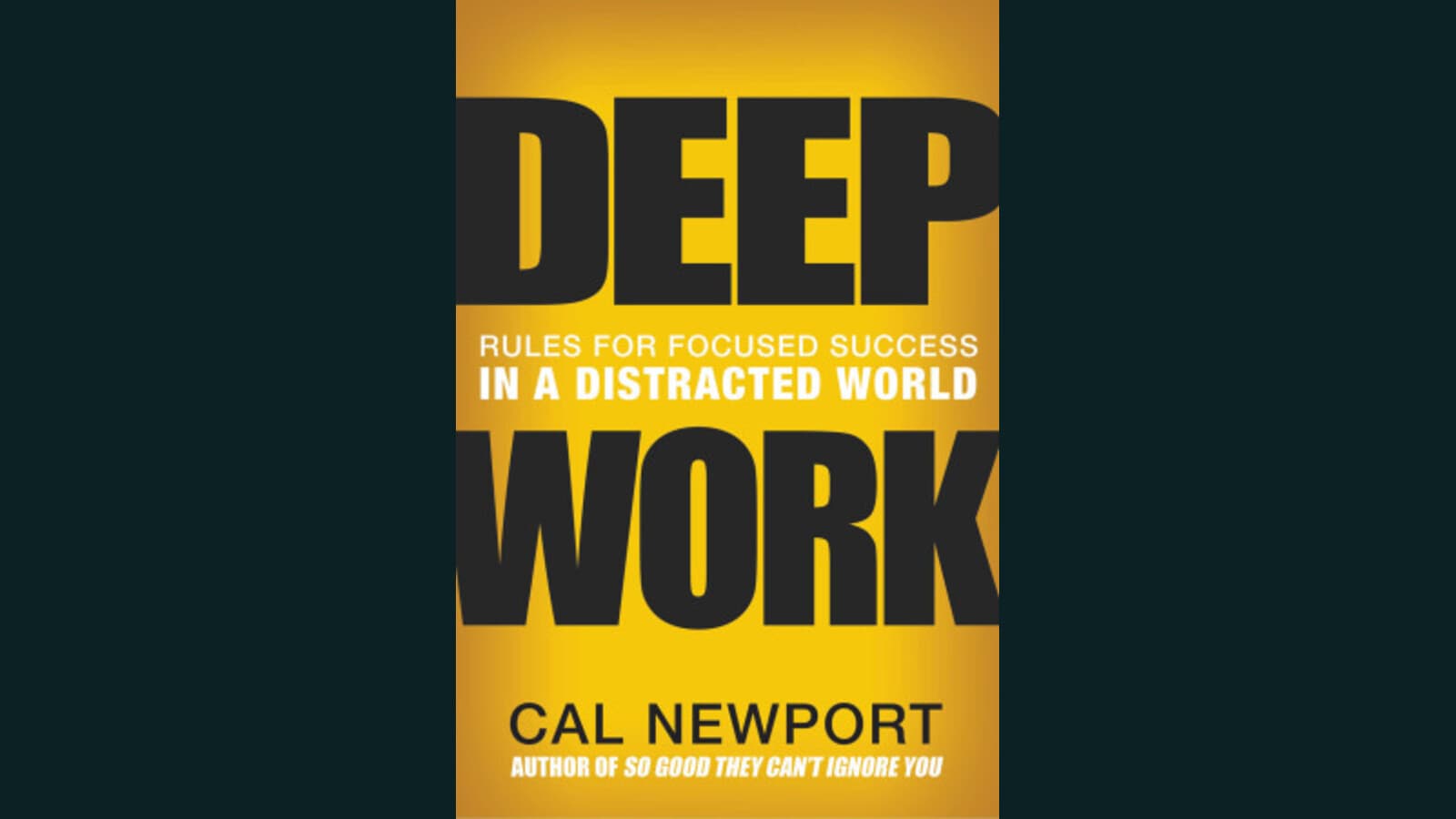
Cal Newport’s books circle one practical problem: how to build a valuable life when work, technology, ambition, and attention all compete for control. His earliest books address students. His later books move through career strategy, focused concentration, digital boundaries, and a critique of overloaded knowledge work. You can read them in publication order, but most readers should begin with the question they need to solve now.
The shortest recommendation is this: start with Deep Work if distraction is preventing you from doing demanding work. Start with So Good They Can’t Ignore You if you are choosing or changing a career and need a more durable idea than “follow your passion.” Those are the two Cal Newport titles currently verified in Readever’s English catalog, and they form a useful pair: one explains how to develop rare concentration; the other explains why developing rare, useful skills matters.
Cal Newport books in publication order
Newport’s main books can be grouped into a student phase and a work-and-technology phase. Publication order shows that progression:
- How to Win at College (2005) — practical strategies for making deliberate use of college.
- How to Become a Straight-A Student (2006) — study systems, planning, and academic execution.
- How to Be a High School Superstar (2010) — an argument for depth and distinctive activity rather than frantic résumé padding.
- So Good They Can’t Ignore You (2012) — career capital, skill, control, and mission.
- Deep Work (2016) — focused effort on cognitively demanding tasks.
- Digital Minimalism (2019) — intentional technology use organized around chosen values.
- A World Without Email (2021) — a critique of constant messaging and the hyperactive hive-mind workflow.
- Slow Productivity (2024) — a proposal to do fewer things, work at a natural pace, and prioritize quality.
This is a publication guide, not a required sequence. The books do not form a narrative series. The two student titles about college can be useful outside their original audience, but working adults usually gain more by entering at the career, focus, technology, or workload question that is currently causing friction.
Where should you start?
Start with Deep Work when attention is the bottleneck
Choose Deep Work when you know what matters but struggle to protect uninterrupted time for it. The book’s central distinction is between demanding work that creates new value and shallow coordination that keeps activity visible. Its practical value comes from forcing you to define what concentration would look like in your actual role.
Do not turn “deep work” into a vague preference for quiet. Identify a task that requires sustained thinking, a measurable output, and a block of time with a clear beginning and end. A programmer may use the block to solve a difficult design problem; a student may use it to reconstruct an argument without notes; a manager may use it to write a decision document rather than clear messages. The relevant unit is not hours of silence but progress on a cognitively demanding outcome.
Read critically, too. Not every job allows long isolated blocks, and collaboration is not automatically shallow. A support specialist, clinician, teacher, or team leader may create value through responsive interaction. Adapt the principle by protecting the most demanding parts of the role instead of copying someone else’s schedule.
Start with So Good They Can’t Ignore You when career direction is the bottleneck
Choose So Good They Can’t Ignore You when you are asking what work to pursue, whether to leave a role, or how to earn more autonomy. Newport challenges the idea that a pre-existing passion should dictate a career. He emphasizes building skills that are rare and valuable, then using that “career capital” to gain control and pursue a meaningful mission.
The book is most useful when converted into an inventory. List the skills your field rewards, the evidence that would demonstrate them, the practice that would improve them, and the opportunities available to someone who becomes unusually good. This moves career reflection away from mood alone and toward experiments that produce information.
The framework still has limits. Labor markets are unequal; access to training, time, health, networks, and financial risk is not evenly distributed. Skill does not guarantee fair recognition. Read the book as a strategy for increasing options, not as a moral claim that every outcome is earned or that structural constraints are irrelevant.
The best two-book sequence
For most working readers, begin with So Good They Can’t Ignore You and follow with Deep Work. The first book helps answer what capability is worth building. The second helps answer how to create the concentration required to build it. Reversing the order also works when an urgent focus problem must be solved before broader career planning.
Use one shared note across both books:
- Valuable skill: What capability would create meaningful options in my field?
- Deliberate practice: What activity stretches that skill and produces feedback?
- Deep task: Which part requires uninterrupted concentration?
- Shallow load: Which recurring coordination can be reduced, batched, clarified, or declined?
- Control: What evidence of value would justify more autonomy?
- Mission test: What small project could test a direction before a high-risk commitment?
This bridge prevents productivity from becoming an end in itself. Focus is useful because it supports learning, craft, service, and high-quality output—not because an empty inbox or a long concentration streak is inherently virtuous.
What to read after the two Readever titles
Choose Digital Minimalism if personal technology use keeps fragmenting your leisure, relationships, or attention. Its key move is to begin with values and then decide which tools support them, rather than optimizing every notification one by one.
Choose A World Without Email if the larger problem is organizational. It treats constant unscheduled messaging as a workflow design failure, not merely an individual self-control problem. Managers should pay particular attention to this distinction: asking employees to “focus harder” will not fix a system that continuously generates urgent coordination.
Choose Slow Productivity if overload comes from too many simultaneous commitments or unrealistic pace. Its argument is broader than working slowly. It asks readers to reduce concurrent obligations, respect variation in pace, and make quality visible over a longer horizon.
The student books remain the better entry for readers who need concrete academic systems. Their examples are tied to school, but the deeper pattern—plan backward, concentrate on high-value work, and avoid performative busyness—connects with the later books.
A four-week application plan
Week one: measure before changing
For five working days, record blocks of demanding work, coordination, administration, and recovery. Do not estimate from memory at the end of the week. Note interruptions and the task you were trying to complete. The goal is to find the real constraint: unclear priorities, excessive commitments, messaging norms, environmental interruption, fatigue, or lack of skill.
Week two: choose one valuable skill
Define one skill and one observable artifact that would demonstrate improvement. “Become strategic” is too vague. “Write a decision memo that compares three options with evidence and trade-offs” is testable. Schedule practice that produces feedback rather than repeating what is already comfortable.
Week three: protect a small deep-work block
Start with a block you can keep consistently. Write a shutdown condition and a fallback plan. If ninety minutes is unrealistic, use forty-five. If mornings are crowded, choose another reliable period. Record output, not just time.
Week four: redesign one source of shallow load
Batch a recurring request, write a clearer process, shorten a meeting, establish office hours, or remove a report nobody uses. Make the change with the people affected rather than quietly becoming less responsive. Productivity systems should improve shared work, not transfer hidden costs to colleagues.
At the end of four weeks, decide what to keep based on output quality, learning, stress, and effects on collaborators. A method that produces private focus while creating public confusion is not a successful system.
How this guide avoids overlap with the Deep Work reading guide
This page owns author-level navigation: publication order, the relationship among Newport’s career, focus, technology, and workload books, and advice on choosing a first title. The planned Deep Work reading guide owns single-book application: chapter-level reading questions, exercises, and implementation for that one title. Readers searching for a Cal Newport bibliography or starting point should land here; readers already committed to Deep Work should use the title-specific guide.
Frequently asked questions
What is the best Cal Newport book to read first?
For most readers, Deep Work is the most direct entry because it addresses a familiar problem and supports immediate experiments. Choose So Good They Can’t Ignore You first when your larger concern is career direction, skill development, or autonomy.
Do Cal Newport’s books need to be read in order?
No. They are standalone nonfiction books. Publication order shows the development of his ideas, but a topic-based order is more efficient for most readers.
Should I read Deep Work or Digital Minimalism first?
Read Deep Work when the main problem occurs during demanding work. Read Digital Minimalism when optional personal technologies are crowding out chosen activities. If both apply, clarify your values and technology rules first, then design focused work blocks.
Is So Good They Can’t Ignore You only for people changing careers?
No. Its career-capital framework can also help someone deepen a current role, plan a stretch project, or earn more control. Readers should still account for labor conditions, unequal opportunity, and constraints that individual skill alone cannot remove.
Choose the problem, then choose the book
If attention is blocking valuable work, open Deep Work on Readever. If you need to decide which abilities and opportunities to build, start with So Good They Can’t Ignore You. Write the decision you want the book to improve before you begin, and test one change rather than collecting a shelf of productivity rules.