A Technical Book Reading Companion for Source-Grounded Learning

Read technical EPUBs with passage-level highlights, contextual explanations, and Book Chat—then verify every important idea in current sources and tools.

Why Technical Reading Breaks Down

A source-aware reading workflow

Readers often get stuck for one of four reasons:

  • Missing prerequisites: the author assumes knowledge you do not yet have.
  • Compressed reasoning: several steps are packed into one paragraph or equation.
  • Unclear scope: a rule works under conditions the reader has not noticed.
  • Passive familiarity: a passage feels understandable until you try to explain or use it. The solution is not to ask AI for a replacement summary. It is to locate the exact gap, make it explicit, and test your understanding.
Why Technical Reading Breaks Down

A Six-Step Technical Book Reading Workflow

A source-aware reading workflow

Before reading closely, inspect the chapter title, headings, diagrams described in the text, and opening or closing sections. Write one sentence:

After this chapter, I should be able to explain or do ______. Keep the target narrow. “Understand distributed systems” is too broad. “Explain why replication can improve availability while creating consistency tradeoffs” is testable. Technical chapters often introduce a small set of terms that control everything that follows. Highlight definitions, constraints, and contrasts—not every new noun. A useful highlight answers at least one question:

  • What is this concept?
  • What problem is it meant to solve?
  • Under which conditions does it apply?
  • What is it being contrasted with?
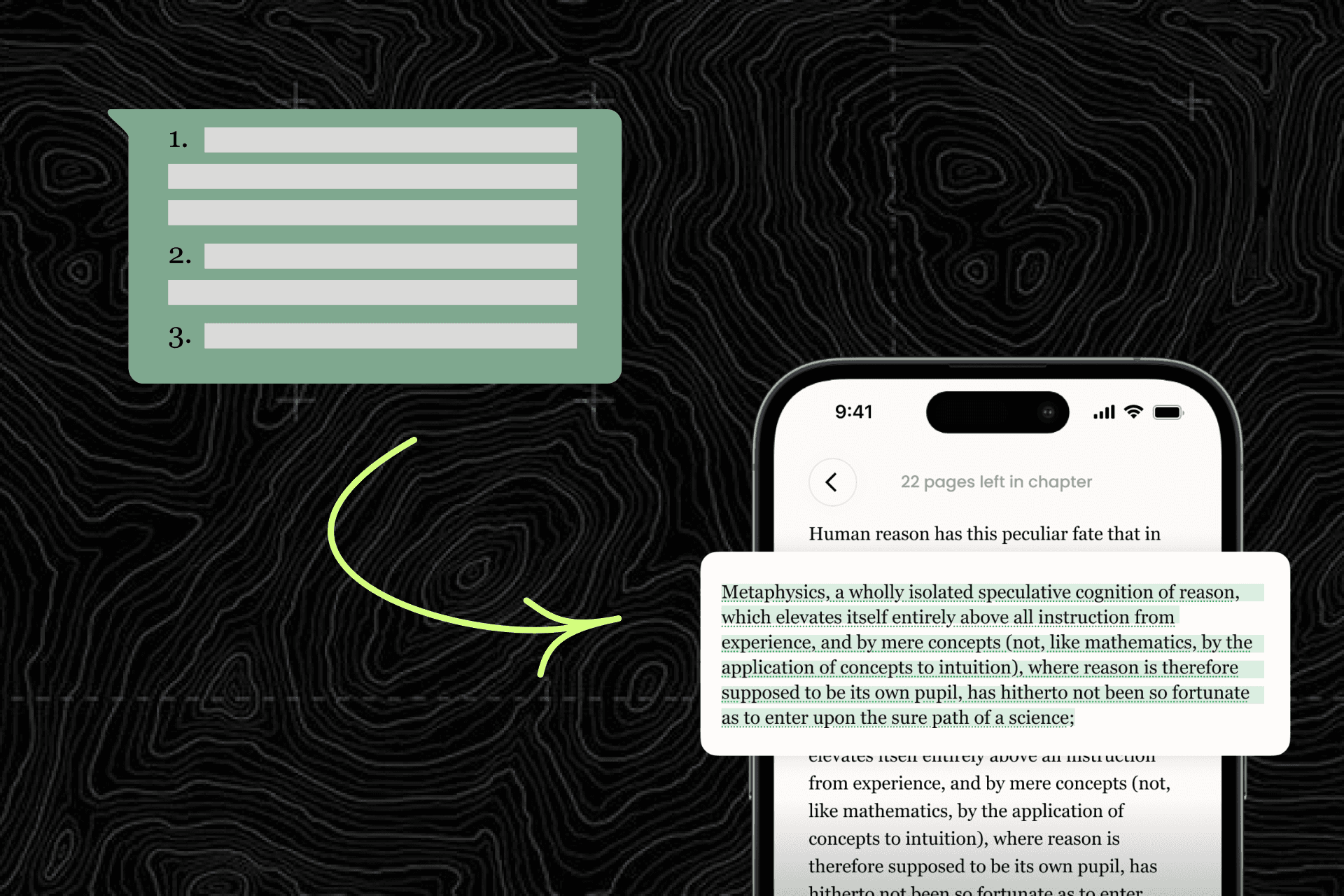
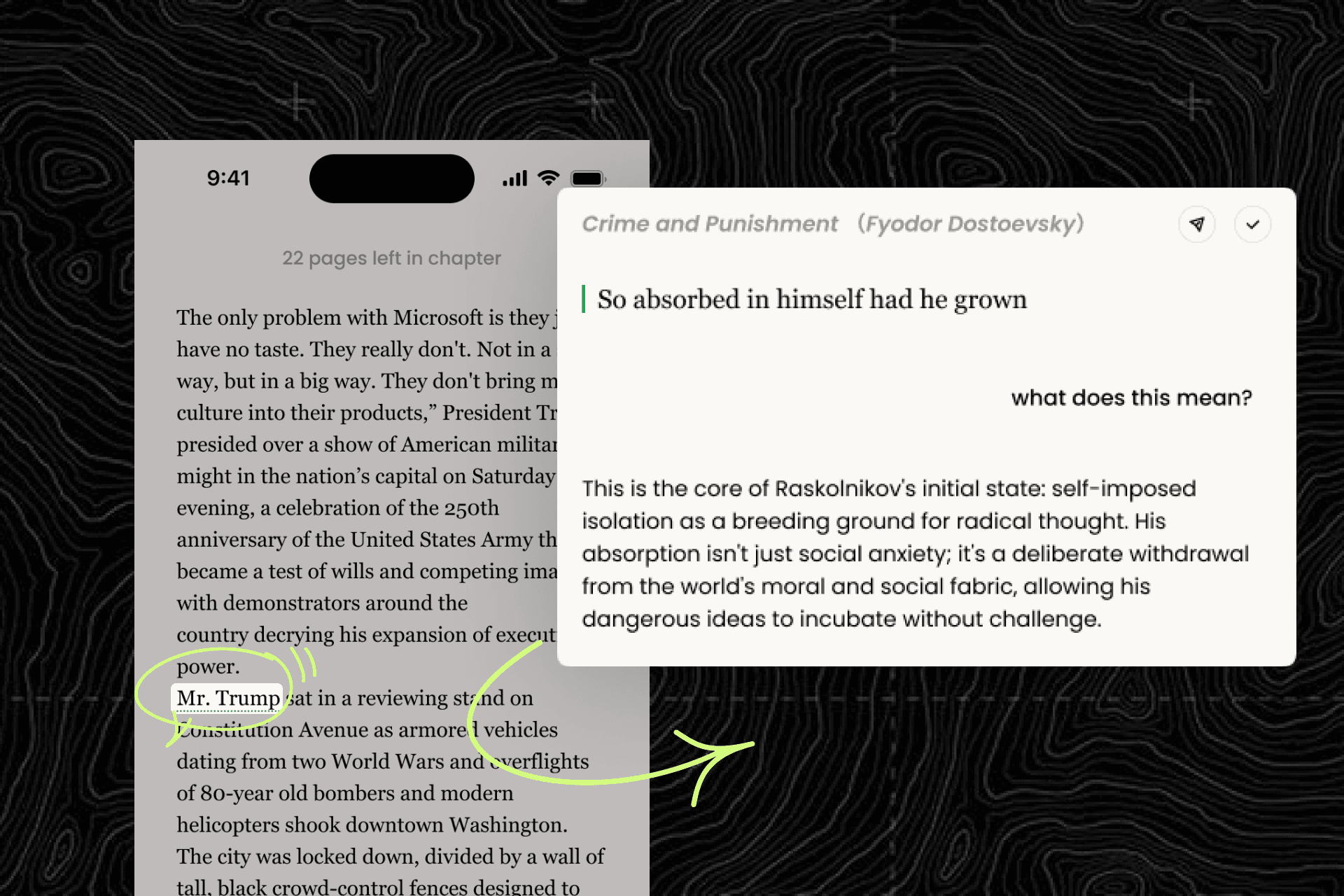
  • What could fail if I use it incorrectly? If a term is unclear, request a contextual explanation tied to the selected passage. Then reread the author’s wording. The explanation should help you return to the book, not replace it. Explore contextual reading assistance When reasoning feels compressed, avoid broad prompts such as “Explain this chapter.” Select the smallest difficult passage and ask a diagnostic question:
  • “What pre
A Six-Step Technical Book Reading Workflow

Prompt Patterns for Technical Reading

A source-aware reading workflow

  • “Explain this term using the vocabulary already introduced in the passage.”
  • “How is this term different from [related term] in this chapter?”
  • “Give a simple conceptual example, then state what the example leaves out.”
  • “List the steps described here in causal order.”
  • “What input, transformation, and output does this passage describe?”
  • “Which step depends on an assumption that may not hold everywhere?”
  • “What benefit and cost are being compared here?”
  • “What would a practitioner need to measure before choosing this approach?”
  • “Suggest a counterexample I could investigate outside the reader.”
  • “Which claims in this passage could change over time?”
  • “What should I verify in current official documentation?”
  • “Separate the durable concept from version-specific details.” These prompts organize your checking. They do not make the response authoritative.
Prompt Patterns for Technical Reading

Prepare with the book in front of you

Use Readever to highlight, question, and understand difficult passages without replacing the source.

Frequently asked questions


Should I read a technical book from cover to cover?

Not always. Read the introduction and structure first, then choose a sequence that matches your goal and prerequisites. Some books build cumulatively; others work well as references. Follow the author’s dependencies when later chapters rely on earlier definitions.


Can Book Chat explain code or formulas in an EPUB?

It can offer a contextual explanation of text you are reading, but the response may be incomplete or wrong. Readever does not execute code or verify calculations. Test important details in the appropriate external environment.


How much should I highlight in a technical chapter?

Highlight selectively: definitions, assumptions, mechanisms, tradeoffs, and boundaries. If almost every paragraph is marked, the highlights no longer help you find the chapter’s structure.


What should I do when a technical book is outdated?

Separate durable principles from version-specific instructions. Compare commands, APIs, standards, prices, regulations, and product behavior with current official sources before using them.


Does this workflow support PDFs or scanned manuals?

This page is limited to a text-first EPUB workflow. It does not claim PDF parsing or OCR for scans.


Can Readever verify whether a technical claim is correct?

No. Readever supports reading and questioning. Verification requires authoritative sources, current documentation, testing, calculation, or qualified human review.

Start your next reading session

Open an EPUB you are allowed to use and build a source-grounded reading workflow.