🎯 Want to master effective reading techniques with AI-powered assistance?
Transform your reading with www.readever.app - Practice SQ3R techniques with advanced AI tools that help you survey texts, generate questions, and review key concepts. Access classic study guides like "How to Read a Book" and "Deep Work" with AI-powered assistance. Perfect for building the study skills you'll need for college success!
What is SQ3R and Why It's Revolutionizing Academic Reading
The SQ3R method, developed by education philosopher Francis Robinson in 1946, remains one of the most powerful reading comprehension systems ever created. This systematic approach transforms passive reading into an active, engaging dialogue with the text. In an era of information overload and digital distractions, SQ3R offers a proven framework for deep learning and retention.
SQ3R stands for:
- Survey - Preview the material before diving in
- Question - Turn headings into questions to guide your reading
- Read - Actively engage with the text seeking answers
- Recite - Summarize key points in your own words
- Review - Regularly revisit material to reinforce learning
Research consistently shows that students using SQ3R demonstrate 40-60% better retention of material compared to those using traditional reading methods. The technique works by engaging multiple cognitive processes simultaneously, creating stronger neural pathways for memory storage and retrieval.
The Science Behind SQ3R's Effectiveness
SQ3R's power lies in its foundation in cognitive psychology and learning science. Each step triggers specific mental processes that optimize comprehension and memory formation:
Cognitive Engagement Theory
SQ3R forces your brain to move from passive reception to active processing. When you formulate questions and recite answers, you're engaging in metacognition—thinking about your thinking—which research shows dramatically improves learning outcomes.
Encoding Specificity Principle
By connecting questions to answers within the same context, SQ3R creates stronger memory traces. Your brain forms multiple retrieval pathways, making it easier to recall information later.
Spaced Repetition Effect
The Review step leverages the spacing effect, where information revisited at increasing intervals is retained significantly longer than information studied in a single session.
Generation Effect
When you generate questions and answers yourself rather than simply reading them, you retain up to 50% more information. This active generation creates deeper cognitive processing than passive reception.
Step-by-Step Guide to Mastering Each SQ3R Phase
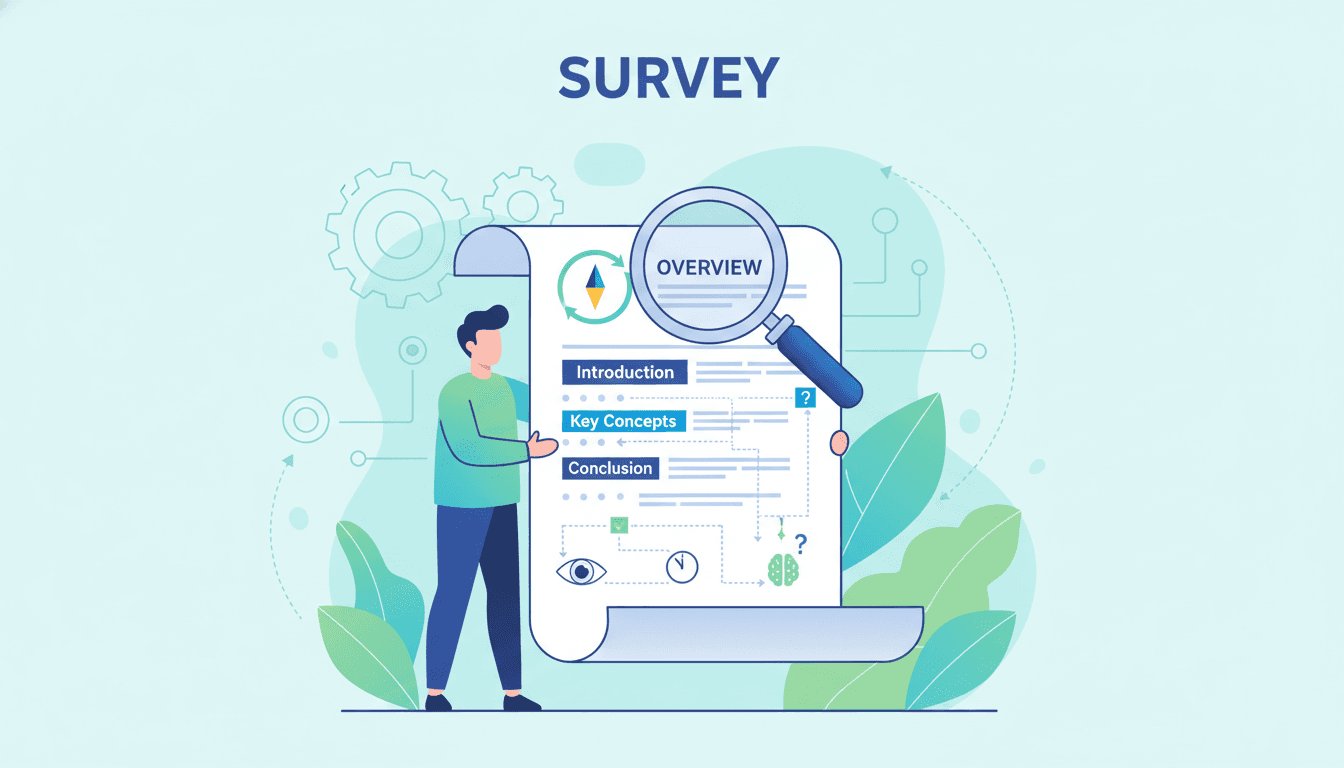
1. Survey: The Strategic Preview (2-5 minutes)
What to do:
- Read the title, introduction, and conclusion
- Scan all headings, subheadings, and bold text
- Look at charts, graphs, and illustrations
- Read the first sentence of each paragraph
- Check for summaries, review questions, or key terms
Why it works: Surveying activates your prior knowledge and creates a mental framework. Your brain begins organizing incoming information before you even start detailed reading, making comprehension 30-40% more efficient.
Pro tip: Create a quick mind map during survey. This visual scaffold becomes your reading guide and helps identify the text's main structure and key relationships.
2. Question: The Inquiry Mindset (1-2 minutes per section)
Transform headings into questions:
- "The Causes of World War I" → "What were the main causes of World War I?"
- "Cellular Respiration Process" → "How does cellular respiration work?"
- "Economic Impact of Trade" → "What effects does trade have on economies?"
Why it works: Questions activate your curiosity circuitry and give your reading purpose. Your brain naturally searches for answers, making reading more focused and engaging.
Advanced technique: Create questions at different cognitive levels:
- Factual: What? Who? When? Where?
- Analytical: How? Why? Compare?
- Evaluative: Should? Which is better? What if?

3. Read: Active Engagement (Variable time)
Reading strategies:
- Read specifically to answer your formulated questions
- Highlight only key concepts (not entire sentences)
- Write margin notes connecting new ideas to existing knowledge
- Pause after each section to mentally summarize
- Look for signal words that indicate relationships (however, therefore, in contrast)
Why it works: Purposeful reading with questions increases comprehension by up to 50% compared to passive reading. Your brain filters information more effectively when it's seeking specific answers.
Digital adaptation: When reading on www.readever.app, use the AI assistant to help identify key passages and generate additional questions as you read.

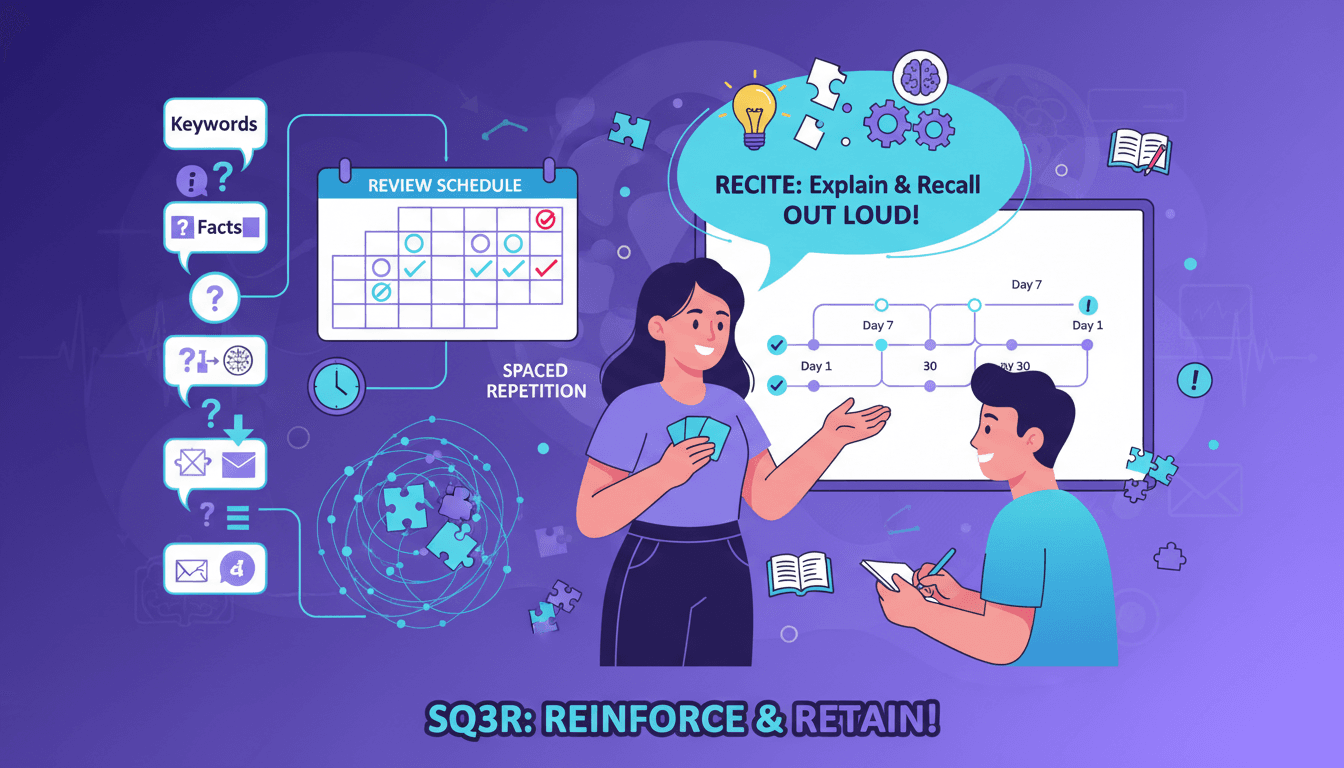
4. Recite: The Memory Consolidation (2-3 minutes per section)
Recitation methods:
- Cover the text and summarize aloud in your own words
- Write a brief paragraph without looking at the source
- Explain concepts to an imaginary person
- Create flashcards with questions on front, answers on back
- Record audio summaries and listen back
Why it works: Reciting forces retrieval practice, one of the most effective learning strategies identified by cognitive scientists. Each successful recall strengthens the memory pathway.
Common mistake: Don't just reread the text. True recitation means generating the information from memory, which builds much stronger retention.
5. Review: Long-Term Retention (5-10 minutes)
Review techniques:
- Look over your notes and highlighted sections
- Review questions you created and their answers
- Connect new information to what you already know
- Identify remaining gaps in understanding
- Plan when to review again (tomorrow, next week, next month)
Why it works: Review moves information from short-term to long-term memory through consolidation. Spaced review sessions can increase retention from 20% to over 80%.
AI enhancement: Use readever's AI features to generate review questions and track your understanding over time.
Applying SQ3R to Different Academic Subjects
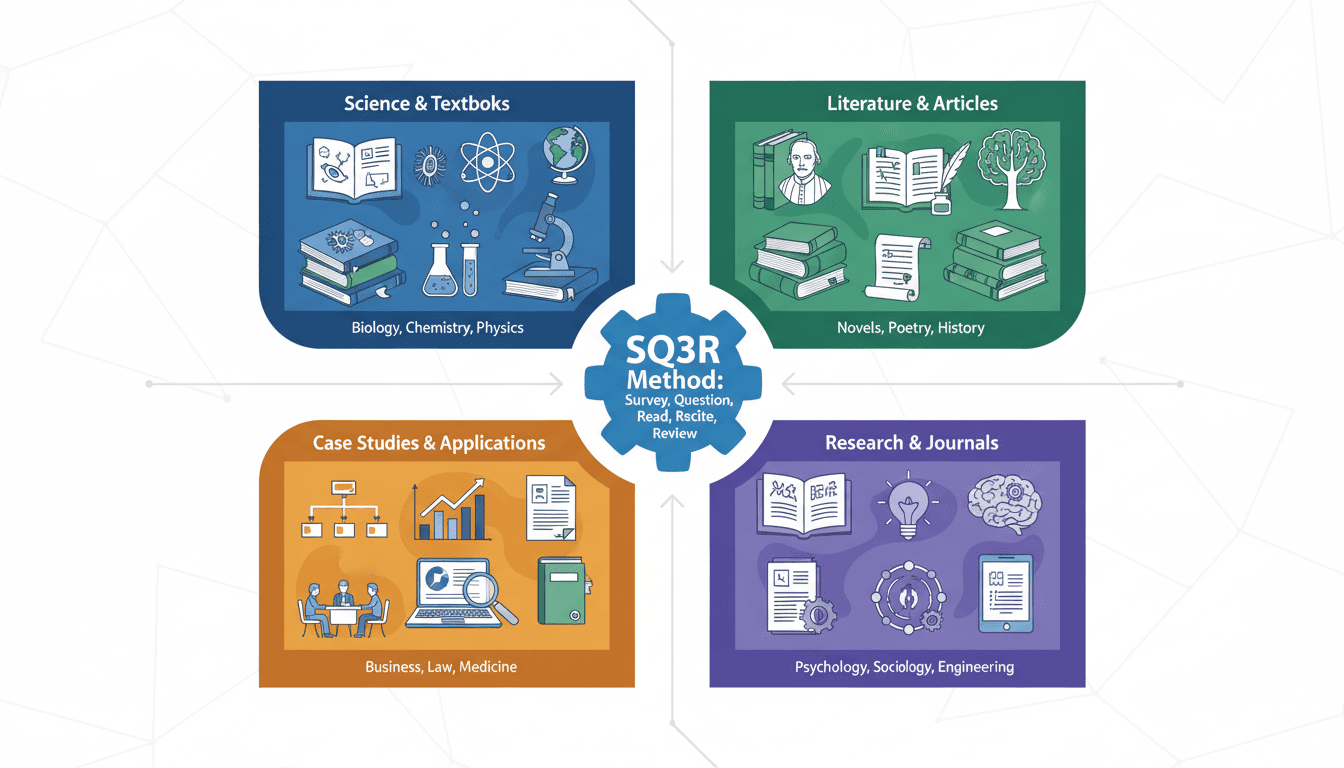
Textbook Chapters
- Survey: Read chapter summary, headings, and review questions
- Question: Convert section headings to study questions
- Read: Focus on answering questions while noting examples
- Recite: Summarize each section before moving forward
- Review: Create chapter outline and practice recall
Scientific Articles
- Survey: Abstract, introduction, conclusions, figures
- Question: What hypothesis was tested? What methods were used?
- Read: Focus on methodology and results sections
- Recite: Explain the study's significance and limitations
- Review: Connect findings to broader field knowledge
Literary Works
- Survey: Read introduction, character list, and plot summary
- Question: What themes emerge? How do characters develop?
- Read: Track literary devices and symbol patterns
- Recite: Analyze key passages and their meanings
- Review: Consider historical context and author's purpose
Case Studies
- Survey: Executive summary and key findings
- Question: What problem was addressed? What solution worked?
- Read: Analyze decision-making process and outcomes
- Recite: Explain lessons learned and applications
- Review: Consider alternative approaches and implications
Common SQ3R Mistakes and How to Avoid Them
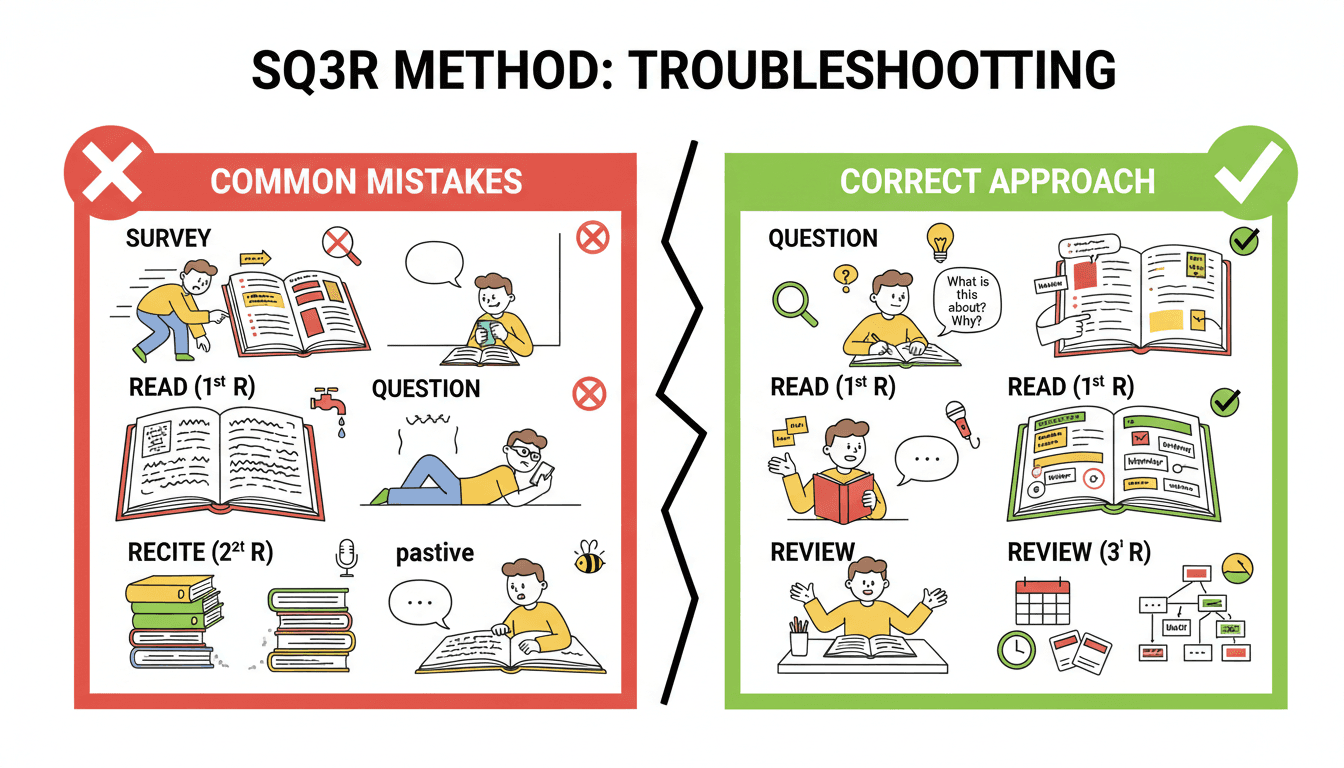
Mistake 1: Skipping the Survey Step
Problem: Jumping straight into reading without context Solution: Always take 2-3 minutes to survey. The time investment pays off in faster comprehension.
Mistake 2: Creating Poor Questions
Problem: Simple yes/no questions that don't deepen understanding Solution: Focus on "how" and "why" questions that require analytical thinking.
Mistake 3: Passive Reading
Problem: Reading without actively seeking answers to your questions Solution: Keep your questions visible and constantly refer back to them while reading.
Mistake 4: Incomplete Recitation
Problem: Briefly glancing at notes instead of generating from memory Solution: Cover all materials and truly test your recall before checking answers.
Mistake 5: Neglecting Review
Problem: Completing SQ3R but never revisiting the material Solution: Schedule review sessions: 1 day, 1 week, and 1 month after initial reading.
Integrating SQ3R with Modern Technology
Digital Reading Tools
- Use readever's AI assistant to help generate questions from headings
- Leverage highlighting features that sync across devices
- Record audio recitations directly in the app
- Set automated review reminders based on spacing algorithms
AI-Powered Enhancements
- Generate additional practice questions beyond the text
- Get instant feedback on your recitations
- Receive personalized review schedules based on your performance
- Access complementary materials that deepen understanding
Note-Taking Integration
- Connect SQ3R questions to digital flashcard systems
- Link recitations to visual mind maps
- Sync review schedules across all your devices
- Track progress and identify areas needing additional work
Measuring Your SQ3R Progress
Immediate Indicators
- Can you answer your questions without looking at the text?
- How does your reading speed compare to before using SQ3R?
- Do you feel more engaged while reading?
Short-term Metrics (1-7 days)
- Test yourself on the material without notes
- Try explaining concepts to someone else
- Complete practice problems or assignments related to the reading
Long-term Indicators (1+ months)
- Can you recall key concepts months later?
- Do you find yourself applying SQ3R automatically?
- Are your grades improving in subjects using the method?
🎯 Ready to transform your study habits with intelligent reading support?
Master SQ3R with www.readever.app - Practice the SQ3R method with AI-powered tools that help you generate questions, track comprehension, and schedule reviews. Access essential study guides like "How to Read a Book" and "Deep Work" with intelligent reading assistance. Join thousands of students who are reading smarter, not harder!
Advanced SQ3R Variations and Adaptations
SQ4R: Adding "Reflect"
For deeper learning, add a reflection step:
- How does this information connect to your experiences?
- What implications does this have for your field of study?
- What questions remain unanswered?
PQ4R: Preview, Question, Read, Reflect, Recite, Review
A variation that emphasizes preview and reflection for critical thinking courses.
SQ3R for Speed Reading
Adapt the method for faster reading:
- Limit survey to 1 minute
- Create 3-5 key questions per chapter
- Read at 400-500 WPM while maintaining comprehension
- Use speed recitation techniques
- Quick review within 24 hours
Collaborative SQ3R
Study group adaptations:
- Share questions with peers
- Take turns leading discussions
- Quiz each other during recitation phase
- Collaborate on comprehensive reviews
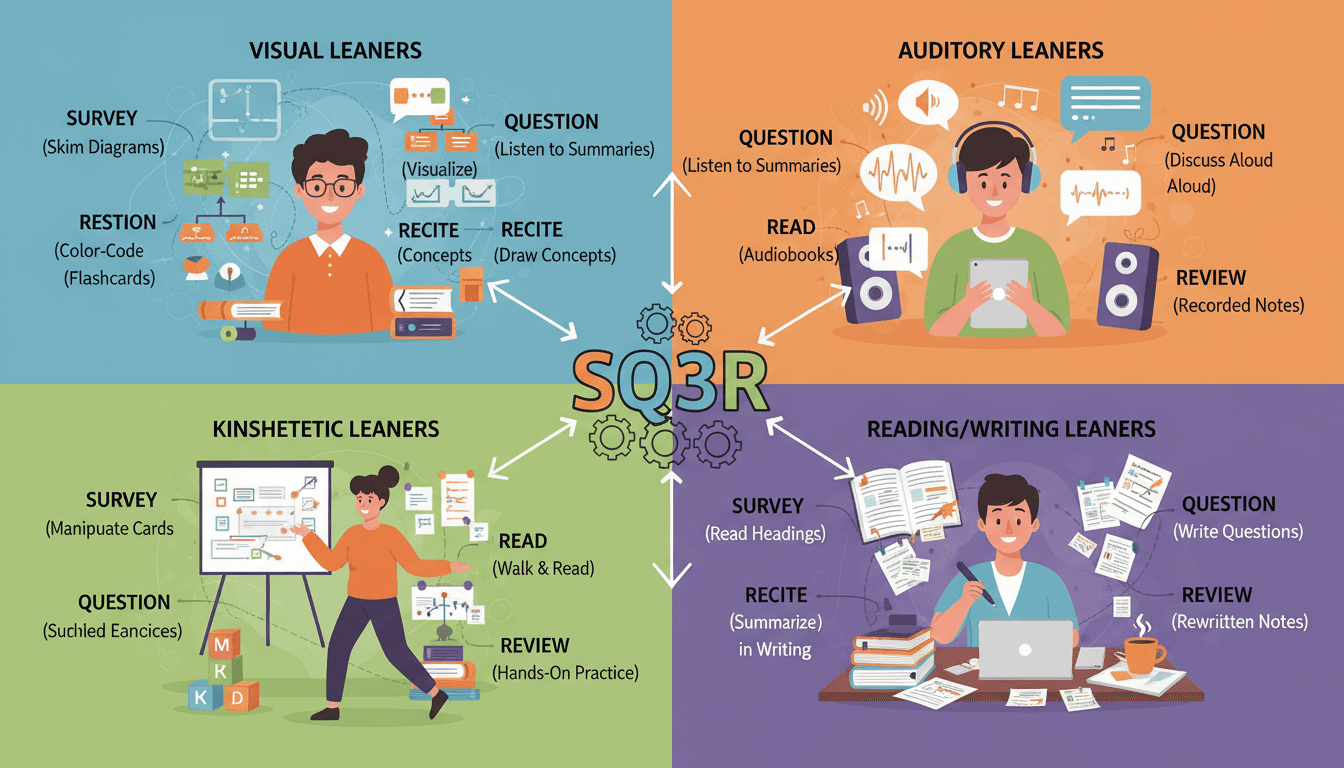
SQ3R for Different Learning Styles
Visual Learners
- Create diagrams during survey phase
- Use color coding for different question types
- Draw concept maps during recitation
- Design visual summaries for review
Auditory Learners
- Record questions and listen while reading
- Recite answers aloud repeatedly
- Discuss concepts with study partners
- Create audio recordings for review
Kinesthetic Learners
- Write questions and answers by hand
- Create physical flashcards
- Walk around while reciting
- Use gestures to explain concepts
Reading/Writing Learners
- Take extensive notes during reading
- Write detailed summaries for recitation
- Create written outlines for review
- Keep a reading journal
Troubleshooting SQ3R Challenges
"I don't have time for all five steps"
Solution: Start with abbreviated SQ3R:
- Survey: 1 minute
- Question: 2-3 key questions
- Read: Focus on answering questions
- Recite: Quick mental summary
- Review: 2-minute check next day
"I can't think of good questions"
Solution: Use question stems:
- What is the relationship between X and Y?
- How does this concept apply to real situations?
- Why is this information important?
- What would happen if this changed?
"I keep forgetting what I read"
Solution: Strengthen recitation and review:
- Recite multiple times for each section
- Use spaced repetition for reviews
- Connect new information to existing knowledge
- Create memory aids and mnemonics
"SQ3R feels too rigid"
Solution: Adapt the method to your needs:
- Modify timing for different subjects
- Combine steps when appropriate
- Skip questions for familiar material
- Add personal touches that work for you
The Future of Reading: SQ3R Meets AI
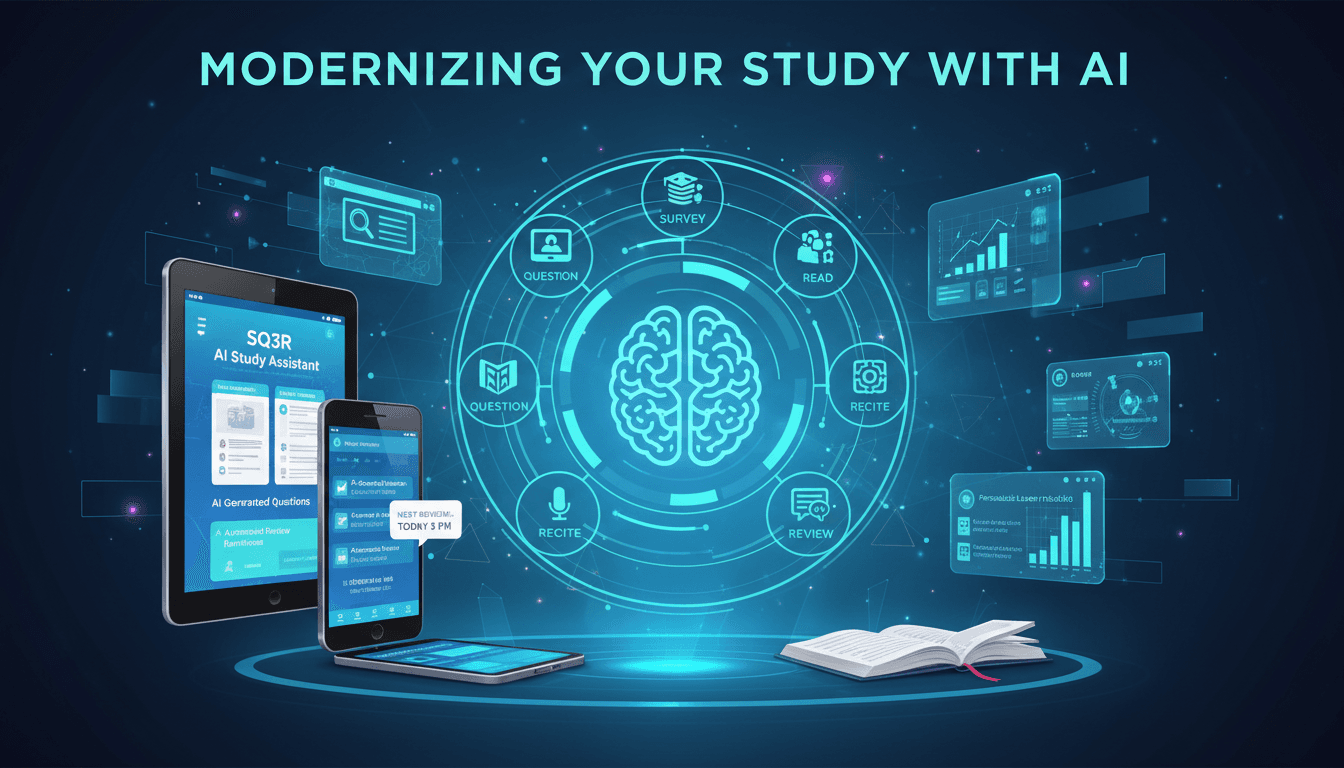
As reading becomes increasingly digital, SQ3R principles remain essential but are enhanced by technology:
AI-Generated Questions
Advanced systems can analyze text and generate thoughtful questions at different cognitive levels, saving time while improving quality.
Adaptive Review Schedules
AI algorithms track your performance and optimize review timing for maximum retention.
Multimedia Integration
Modern SQ3R can incorporate videos, interactive simulations, and virtual reality experiences to deepen understanding.
Personalized Learning Paths
AI can identify your learning patterns and adapt SQ3R implementation to your specific needs and strengths.
Building Lifelong Reading Habits with SQ3R
The true power of SQ3R extends beyond academic success to professional development and personal growth:
Professional Reading
- Use SQ3R for industry reports and research papers
- Apply the method to learn new skills and stay current
- Adapt techniques for rapid information processing
Personal Development
- Read self-help books with deeper comprehension
- Apply SQ3R to news and current events
- Use the method for learning hobbies and interests
Teaching Others
- Share SQ3R techniques with colleagues and family
- Help children develop strong reading habits
- Mentor others in effective learning strategies

FAQ: Your SQ3R Questions Answered
Q: How long does it take to complete SQ3R for a typical textbook chapter? A: Initially, SQ3R might take 30-50% longer than regular reading. However, as you become proficient, you'll read faster and retain more, actually saving study time in the long run.
Q: Can SQ3R work for fiction reading? A: While designed for non-fiction, modified SQ3R can enhance literary analysis. Focus on themes, character development, and literary devices rather than factual information.
Q: Should I use SQ3R for every reading assignment? A: Prioritize SQ3R for dense, important material. For lighter reading, use abbreviated versions. The key is developing the habit of active reading.
Q: How do I handle digital distractions while using SQ3R? A: Use apps that block distracting websites, turn off notifications, and create a dedicated reading environment. The structured nature of SQ3R actually helps maintain focus.
Q: Can SQ3R help with test preparation? A: Absolutely. SQ3R's review component is perfect for exam prep. The questions you create become natural study guides, and the recitation practice builds confidence for test-taking.
Q: How long before I see results from using SQ3R? A: Most students notice improved comprehension immediately. Significant improvements in grades and retention typically appear within 2-3 weeks of consistent use.
Q: Should I use SQ3R for group study sessions? A: Yes! SQ3R provides an excellent framework for collaborative learning. Group members can divide question-creation and compare recitation results.
Q: Can children learn SQ3R? A: Simplified versions work well for middle school students and above. The core concepts of questioning and reviewing are valuable at any age.
Start your SQ3R journey today and transform the way you read, learn, and retain information. The skills you develop will serve you throughout your academic career and beyond.